Showing posts with label Least Bittern. Show all posts

Tuesday, June 30, 2015

Hitting the Jackpot!!!

Recently after going to the birding camp up in the Chiris I have kept in touch with Walker Noe, he and I talked about birding at the B and M and maybe even Tres Rios if we had the time. Now, neither Walker nor I are what I would call experienced planners. After going back and forth on where we should bird at we finally decided to just meet at the B and M and wing-it from there. I had one target bird for the day and that was the Yellow-billed Cuckoo, which I have heard but never seen in the county, and Walker also had one main target which was his very overdue lifer Barn Owl. As soon as we arrived at the B and M we were greeted by an Osprey who posed for us.

Osprey

Once we started walking north along the road it didn't take us long to locate my target Yellow-billed.

Yellow-billed Cuckoo

We gave up trying to get better views of the cuckoo shortly after losing the bird. We then decided to look for our second target of the day, the Barn Owl. Somehow three of the four fledgling Barn Owls died and after finding bullet shells under where the fledglings were staying it kinda summed up my investigation. However, one of the fledglings survived and the parents are still healthy.

Barn Owl


After locating these birds we were content with our day, but we looked at the clock and saw that it was only 6:00A.M. and we still had nearly five hours left to bird! So, from the B and M we hiked east towards the west end of the Tres Rios Overbank Wetlands. On our way there we had to hike through a quarter mile of barren ground which is excellent for Lesser Nighthawks, we even found a female incubating two little brown eggs.

Lesser Nighthawk


After observing the nighthawks we hiked further to the west end of Tres Rios which has many mature cottonwoods. On our way we passed by a nice green area which looked like it would be good habitat for almost any eastern vagrant and I jokingly said "What if there was a Painted Bunting in this patch?!" We laughed at how unlikely that would be but I have been having a lot of luck when it comes to pointing out stuff like that, so who knows! Before long we reached the west end of Tres Rios where we picked up a few more awesome species, like two more Yellow-billed Cuckoos, a Bullock's Oriole, a few more Blue Grosbeaks, and Walker's overdue lifer Yellow-breasted Chat. While scanning the large trees in search of anything else we decided to hike towards 91st Avenue which is about 2.5 miles from the west end. While Walker and I were talking and laughing at dumb "bird jokes" I spied a super distant bird on the top of a mesquite tree. After putting my binocs on I thought of many birds in my head "Baltimore Oriole? No. Orchard Oriole? No. What the heck, Walker, I see a male Painted Bunting!!!!!!!"

Painted Bunting!!!!

For a split second Walker thought I was just joking with him, but once he saw that I was serious we both nearly had heart-attacks!! The PABU was in an area where we couldn't get any closer because the trees were too thick to see through, but we enjoyed our distant but unbelievably awesome discovery! The bird then popped down into the super thick jungle of mesquites and we then decided to move on and see if our blessed day would get any better. While Walker and I were hiking further along the road we were still in shock of the amazing bird and we couldn't stop saying "What the HECK!!!". Once we reached the area where the trail splits into two we took the other side of the trail back west. The first area we checked out was a thick jungle of willows. While we scanned the area a Barn Owl flushed and a flock of forty-some grackles came out of nowhere and nearly harassed the owl to death! We continued on our way back to the bunting when Walker walked up to the edge of some reeds and I quietly screamed "STOP!" Walker turned around as if I screamed bloody murder (which I probably did). I then pointed out a Least Bittern about ten feet away!

Least Bittern


Least Bitterns are always a treat to see and I never take them for granted. The first time I had good looks of a Least Bittern, I actually heard it giving a very strange call first and after scanning the area where the call was coming from for over five minutes I finally found the source of the sound and I nearly fell in the lake in astonishment! Since then I have seen MANY Least Bitterns and I always stop to look at this awesome marsh-dwelling heron. After observing one of my favorite birds we had to move on as the heat was starting to creep up on us a little ("a little" as in "a little" over 100 degrees!), and before reaching the bunting spot a flock of three Caspian Terns flew over!

Caspian Tern


After the terns flew over, Walker and I had to try to avoid seeing or hearing any other birds so that our brains wouldn't explode from birding too hard! But despite our attempt we couldn't stop from hearing the song of the male Painted Bunting creeping in our muffled ears! However, Walker and I endured the pain of our exploded brains (and the now 105 degree heat) and searched for the singing bunting once again. This time the bunting was a lot more cooperative and provided mind-blowing views!

Painted Bunting
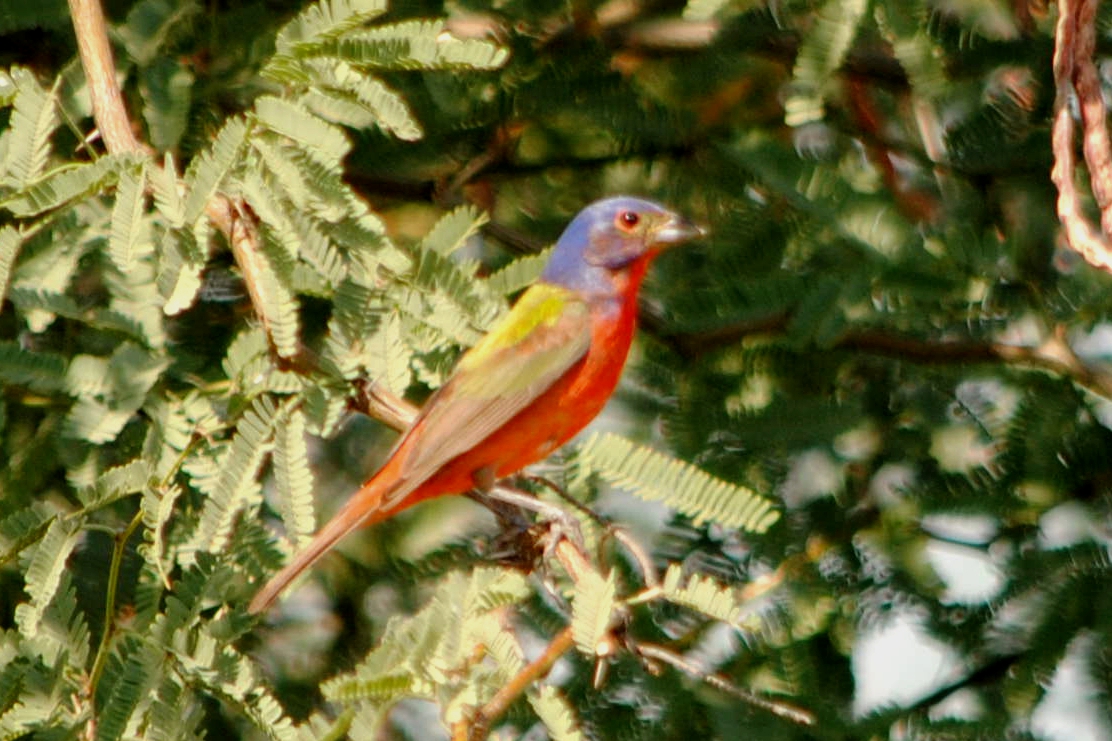

For you readers who survived the mind blow here are a couple less shocking photos.

Painted Bunting


Seeing all of these awesome birds was awesome! The PABU took the cake, no doubt in any mind, while the owls, nighthawks, and cuckoos gave the cake the perfect amount of icing, but after adding the Osprey crush, the Least Bittern crush, and the Caspian Terns flying over, I think the cake was inedible, but I still took it and here I am alive and unhealthy! After the awesome half day of birding with Walker I returned to the B and M and Tres Rios a few days later to show Mr. Joe Ford and Mr. Paul Doucett the bunting. We didn't just find the bunting but had great views of a Great Horned Owl!

Painted Bunting


Great Horned Owl

Seeing the Great Horned was kinda like a welcome to the the owler's club. Why am I all the sudden a huge owl fan? Well you'll have to wait till my next post to find out. But until then keep those nocs in reach and "Bird HARD!!!"

Thursday, May 7, 2015

Baseline and Meridian Wildlife Area

The Baseline and Meridian Wildlife Area is one of my favorite places to go when it comes to birding. "Why?" you might ask, well way back when I was a beginning birder I was introduced to this under-birded hotspot at a festival called "The Tres Rios Festival". Now don't let that name fool you, this is not the big Tres Rios site that you need a permit for, the B and M is about five miles west of Tres Rios. When I started birding around this area I was fortunate to be accompanied by Mr. Joe Ford, and we guided people around the marshy riparian area all day. That day I fell in love with this area! From then on I have been doing Important Bird Area (IBA) counts 3-5 times a year at the B and M. Away from IBA counts, I come to this spot anywhere from 12-22 times a year. The B and M has an amazing diversity of bird life. One of the most abundant habitats that the B and M offers is its marsh, which of course attracts large numbers of marsh birds. As a matter of fact, this very spot is one of the very few places in Maricopa County where you can find the endangered Yuma Ridgway's Rail. The marshy habitat also attracts large numbers of Virginia Rails, Soras, and Least Bitterns, it has also had American Bittern a few times! The second best habitat that the B and M offers are its many riparian stands of Fremont Cottonwoods and Goodding's Willows.

 Here is a map on how to get to the B and M from 91st Avenue, as well as another map of the B and M.

Map courtesy of Tommy DeBardeleben and Google

(The green highlighted path shows some of the trails, the car shows where to turn off, and the "P" stands for parking)

Here is one of the maps that I enhanced.

Below I explain what all of the colors are for.


Ridgway's Rail

Out of all of the awesome birds that can be observed at the B and M the most sought after would be the endangered yumanensis (Yuma) Ridgway's Rail. For those who are unfamiliar with the Clapper Rail split, the Clapper Rail was split into three species in 2014: Mangrove Rail which is found in Venezuela and Brazil, the Ridgway's Rail which is found from northern California down along the Colorado River, into a few spots along the Gila River and down along the Pacific Coast into Mexico, and the Clapper Rail who is found throughout the United States from Texas up to New York. The subspecies of Ridgway's Rail that is found in Arizona is the yuma or yumanensis which reaches its furthest west on the Salton Sea and goes as far east as the B and M. There are 2-4 pairs of RIRAs that breed at the B and M every year arriving by late March and staying until late September. The only pair that can be viewed without spending hours out, are seen along the tall bank which on the map is highlighted as a red trail, one must scan the reed-line often to make sure not to overlook any Ridgway's Rails or Virginia Rails, Soras, Least Bitterns, and possibly an American Bittern. All of the other red dots that are shown on the map are places where I have heard or seen RIRA. Using playback for Ridgway's Rail is strictly illegal because the yumanensis subspecies of the Ridgway's Rail is considered endangered. If searching for the RIRA one must have alot of patience, even though the RIRA stay in the reeds or sometimes along the reed-line they can also be seen on dry ground, but they are never far from water. Here is a photo of what I call the "Rail Pond" which is viewed by the tall bank. To listen to the Ridgway's Rail calls click here.

Rail Pond
Make sure to especially keep an eye on the end of the pond (top right part of photo) because the rails seem to favor that end, but they can also be seen on the other end or along the reed-line.

Sora

Virginia Rail

For those who like marshbirds the Sora and Virginia Rail are a little easier to view than the Ridgway's Rail, and they can be seen almost anywhere where there are reeds. The Sora and Virginia Rail are secretive birds that won't come out unless they think there are no threats (in other words people), and it can be pretty hard to dodge the eyes of a bird. So, for the best chance of seeing either of these rails one must be very quiet, patient, and should try not to make any sudden movements. To listen to Sora calls click here, and to listen to Virginia Rail calls click here.  

Least Bittern

The Least Bittern (like the rails) is a marsh dweller. But to add to its difficulty in viewing, the LEBI will not just flush or retreat into the reeds, it will sometimes just stay still until you are within a few feet and then it will flush in front of your face! To avoid such frustration, try scanning all marshy habitat from down to the base of the reeds all the way to the top because these birds can be at any elevation. I have even observed a LEBI climb 30 feet up a willow! To listen to Least Bittern calls click here.

Yellow-billed Cuckoo
Unfortunately I have not been able to see any Yellow-billed Cuckoos at the B and M, but I have been able to hear them a couple times. The Yellow-billed Cuckoo is another breeder at the B and M, with at least 1-2 breeding pairs making the B and M their nesting grounds. The YBCUs is the latest breeding bird to arrive, as they don't start showing up until early June. As shown on the map in white, the YBCU covers a lot of the river but in very low numbers. The best spot to find them is in the large stand of willows that are found just east of the bridge and on the northern half of the riverbed. But they can also be found on the west side of the bridge or I have actually heard them on the south side of the riverbed east of the bridge in the tamarask forest. Yellow-billed Cuckoos are hard to detect unless they are flushed or heard calling, because of their unique feeding techniques of sitting motionless until they find their prey. To listen to Yellow-billed Cuckoo calls click here.

Barn Owl

Great Horned Owl

The Barn and Great Horned Owls at the B and M are usually easy to locate. As shown on the map by purple. Both of these owl species can be found under the northern half of the long Avondale Bridge but they will not always be under the bridge because they will usually leave for the day if disturbed. Both species are known to nest at this spot and they might be harder to locate during the winter months.

Riparian Habitat
The riparian habitat (highlighted in yellow on the map) is well worth checking out at the B and M. All of the riparian areas that I have highlighted have had or I suspect to have good potential for rarities. The riparian stand that goes under and across the bridge on the northern side of the riverbed (known as "The Stand") is one of the best spots at the B and M to find rarities. In the past it has had Winter Wren, White-throated Sparrow, American Redstart, Eastern Phoebe, Orchard Oriole, Northern Parula, and more! Other than rarities The Stand has many birds nesting in it like a pair of Yellow-billed Cuckoos! Checking these riparian areas is always different but they are productive year-round.

Eastern Phoebe

 White-throated Sparrow

More birds that can be found around the B and M
During the Winter months at the B and M keep an eye out for Northern Shoveler, American Wigeon, Gadwall, Cinnamon, Blue-winged, and Green-winged Teals, American White Pelican, Northern Harrier, Cooper's and Sharp-shinned Hawks, Peregrine and Prairie Falcons,Virginia Rail, Sora, Greater Yellowlegs, Spotted Sandpiper, Wilson's Snipe, Belted Kingfisher, Red-naped Sapsucker, Northern Flicker, House and Marsh Wrens, Blue-gray Gnatcatcher, Ruby-crowned Kinglet, Orange-crowned, Yellow-rumped, and Black-throated Gray Warblers, Spotted and Green-tailed Towhees, Lincoln's, White-crowned, and Brewer's Sparrows, Dark-eyed Junco, and Western Meadowlark . The more uncommon to rare birds that can be seen in the Winter at the B and M include: Common and Hooded Mergansers, Western Grebe, Brown Pelican, American Bittern, Ring-billed Gull, Eastern Phoebe, Winter Wren, Black-and-white and Chestnut-sided Warblers, American Redstart, Northern Parula, Swamp and White-throated Sparrows, and American and Lawrence's Goldfinches. During the hot Summer months keep an eye out for Ridgway's Rail, Lesser Nighthawk, Yellow-billed Cuckoo, Black-chinned Hummingbird, White-winged Dove, Western Kingbird, Cliff Swallow, Lucy's Warbler, Yellow-breasted Chat, Lazuli Bunting, Blue Grosbeak, Summer and Western Tanagers, Brown-headed Cowbird, and Bullock's and Hooded Orioles. In Spring (April-May) and Fall (late August-early October) migration the B and M is an exiting place to go birding because you never know what you might see! Swainson's Hawk, Caspian and Black Terns, Willow Flycatcher, Cassin's Kingbird, Bells, Plumbeous, Cassin's, and Warbling Vireos, Tree, Violet-green, Barn and Bank Swallows, Nashville, MacGillivray's, Yellow, Townsend's Hermit, and Wilson's Warblers, Chipping Sparrow, Black-headed Grosbeak, Indigo Bunting, and Pine Sisken can be seen if one selects the right rout. Birds that tend to stay around the area year-round include: Black-bellied Whistling-Duck, Mallard, Gambel's Quail, Pied-billed Grebe, Neotropic and Double-crested Cormorants, Great Blue and Green Herons, Great and Snowy Egrets, Black-crowned Night-Heron, Least Bittern, White-faced Ibis, Black and Turkey Vultures, Red-tailed Hawk, American Kestrel, American Coot, Common Gallinule, Black-necked Stilt, Killdeer, Rock Pigeon, Eurasian Collared, Mourning, and Common Ground-Doves, Greater Roadrunner, Great Horned and Barn Owls, Anna's and Costa's Hummingbird, Gila and Ladder-back Woodpeckers, Gilded Flicker, Black and Say's Phoebes, Ash-throated Flycatcher, Common Raven, Northern Rough-winged Swallow, Verdin, Black-tailed Gnatcatcher, Crissal Thrasher, Northern Mockingbird, European Starling, Common Yellowthroat, Abert's Towhee, Song Sparrow, Northern Cardinal, Red-winged Blackbird, Great-tailed Grackle, House Finch, Lesser Goldfinch, and House Sparrow.

During all times of the year make sure to drink lots of water as it is very dry out here in Phoenix Arizona! The Baseline and Meridian Wildlife Area is sadly under-birded and I need your help to give this birding hotspot the attention it deserves. So please bird the B and M and enjoy the awesome wildlife that it provides!


Wednesday, July 30, 2014

My first time as a guide!

California has some amazing wildlife photographers like Brian Small (one of the best out there). On July 26th and 27th I had the honor of guiding one of those photographers, Mr. Steve Kaye.  Mr. Steve has only been doing bird photography for three years and he is in my opinion nearly as good as Brian Small! On the 26th Mr. Paul Doucett and I guided Mr. Steve at the Tres Rios Overbank Wetlands off of 91st. It has been about four months since I have last birded this area. We arrived at the wetlands at 4:15PM, it was about 105 degrees out, pretty hot huh! As we approached the wetlands I could already hear a couple of Least Bitterns giving their rail like calls. Black-crowned Night-Herons, and American White Pelicans were flying over the thick marsh.
                                                        Black-crowned Night-Heron
                                                          American White Pelican
 I must apologize because I did not take many photos, instead I tried to help Mr. Steve with all of the birds we saw. We encountered many Lesser Nighthawks and a Great Horned Owl as it started to get darker and we had very close views of a female Least Bittern which I was able to get an okay photo of.
                                                                     Least Bittern
Before we knew it it was already dark so we called it a day. After getting about three and a half hours of sleep Ms. Haylie Hewitt picked me up and there we were off again Mr. Steve, Ms. Haylie, and I at the Baseline and Meridian Wildlife Area (AKA the B and M). I love this area and I pretty much know where all of the birds are at this spot. When we parked the car it started raining so we waited a little before heading out. We started at the "Virginia Rail Pond" and it was not hard to pick him and the female Least Bittern out.
                                                                  Virginia Rail
As you can see with this photo the cloud cover was extremely thick and I was not able to get the best photo of him today but here are some photos I took of the exact same bird about a month and a half ago.


I did not take many photos again on this trip, either because it was super cloudy and I was busy helping Mr. Steve.  But hey, that's what it's like being a guide. I was able to show Mr. Steve the Barn Owls and a few other birds, but our next stop was at the Hunter's Ponds in search of Burrowing Owls. It was not hard finding the owls and we also had a few Black-necked Stilts fly over us.
                                                                  Black-necked Stilt
Before I knew it our mornings birding was over. Later that afternoon when I was at our friends house I found this Pacific-slope Flycatcher.
                                                               Pacific-slope Flycatcher

I was also trying to photograph one of the most depressing birds in the bird world, the Inca Dove. The Inca Dove was singing his "no hope" song over and over, which gave me a depressed feeling, they surely must have been saying "there is no hope for Caleb to get a photo of us" but I proved them wrong!
I know that this is not the best photo but it's a start! I must thank Mr. Paul and Ms. Haylie for helping with my adventures I could not have done it without you guys!

Tuesday, July 22, 2014

Birding With The Pro's

On July 15th I took a trip out to the Baseline and Meridian Wildlife Area, (also know as the B and M) with my friends Mr. Joe Ford, and Mr. Tommy DeBardeleben. Mr. Tommy was having trouble finding the Ridgway's Rails, as I was having trouble finding the Yellow-billed Cuckoos, so we decided to join forces and try to get them both. Mr. Ford however, had been on an out of state trip while these birds were being reported so he would be satisfied with any rails, bitterns, or cuckoos.We started out on the tall berm where we looked and listened for the clappers but came up empty, we then headed over to the Virginia Rail pond where we quickly found the young rail out in the open. The rail was to far for me to take any photos, so I just observed it through my binocs instead. A couple of Least Bitterns were also around the pond and one of them even gave us close up views!
                                                                        Least Bittern
While we were watching the bitterns Mr. Tommy and I heard the Yellow-billed Cuckoo call from behind us in the the thick forest of tamarisks, but once we walked over to the area where we heard the bird we had nothing notable except for a couple of male Lazuli Buntings.
                                                                      Lazuli Bunting
We then walked over to where the cuckoos used to be, near the north side of the river, but came up empty. But we did see a Lesser Nighthawk, a single Barn Owl, and many Blue Grosbeaks. We tried long and hard for those cuckoos but just could not find them. We then walked back to the Ridgway's Rail pond to look for the rails one more time. We sat down for about five minutes when Mr. Tommy and I both looked down at the same time and spied the rail. Can you find the bird in the following photo?
                                                              "Yuma" Ridgway's Rail
Once Mr. Tommy and I took a couple of shots we ran down to a small clearing in the reeds, but by the time we got down the tall berm and to the clearing Mr. Ford said he saw the bird pass the clearing. Mr. Tommy and I knelt down on the dead reeds where we waited for a good three minutes, we knew the bird should come back out at any time so we waited a bit longer, when we saw the bird come out right in front of us!! The rail was only about 18 feet from where we stood and our nerves took over, but the bird stayed out long enough for us to get a couple of decent shots.
                                                              "Yuma" Ridgway's Rail
All three of us were stoked! After the bird disappeared into the cattails it was a time of high-fives, fist-bumps, and fist-pumps. Thank you Mr. Tommy, and Mr. Ford for the awesome trip and memories, and congrats on getting your "B and M Big Five" Mr. Tommy.