Showing posts with label Tropical Kingbird. Show all posts

Saturday, June 18, 2016

Reaching The Triple Three In Maricopa!

About a month ago Ms. Melanie Herring and Ms. Barb Meding were birding at Hassayampa River Preserve when they found a Thick-billed Kingbird! Thick-billed Kingbirds are very rare for Maricopa County with only a hand full of records (the only other record I know of was from this same spot but eight or so years ago). When I saw their listerve report I was shocked! I wanted to chase that bird right away but due to the preserve's hours and days they were open I wasn't able to chase this magnificent find. As a matter of fact, nearly a whole month went by and the bird was still being seen and I couldn't get out to see it! However, a quick call to my birding mentor, Mr. Joe Ford, changed my luck and before I knew it we had a whole group of people who wanted to see this bird. Now Mr. Ford is a good birder and an amazing teacher! As a matter of fact, Mr. Ford played (and still plays) a big part in my birding career and I have him to thank for where I now stand as a birder.On June 18th I woke up early in the morning to meet up with Mr. Ford, Mr. Paul Doucett, Ms. Mitra Samadani, and Mr. Jerry and Ms. Linda Molinelli to bird hard at the Hass! There were two possible Maricopers that I could get at the Hass, Thick-billed Kingbird (of course) and Purple Martin (usually just seen as a flyover by lucky birders). Arriving at the Hassayampa River Preserve, we observed a beautiful male Broad-billed Hummingbird flying back in forth from the trees to the feeders.

Broad-billed Hummingbird

Moving on with the hummingbirds we quickly hit the Mesquite Meander Trail (where there have been Thick-billed and Tropical Kingbirds) in hopes of Maricopering it hard! Yellow Warblers and Yellow-breated Chats were singing like crazy, out in the distance I heard the distinctive squeaky call of the Thick-billed Kingbird! We hiked down the trail further to where it was calling from and then, bam, Thick-billed Kingbird!

Thick-billed Kingbird--Maricoper #333!!!

It didn't hit me until now that the Thick-billed Kingbird was my 333rd species I had seen in Maricopa, what a cool milestone!

Thick-billed Kingbird

This photo almost shows how loud TBKIs are!

Thick-billed Kingbird

The Thick-billed Kingbird is a Mexican bird which reaches its furthest northern range in southeastern Arizona. Up until last month (when I was in SEAZ with Walker and Dalton) I had never seen a TBKI and it almost became a nemesis bird for me, however, Walker saved the day with his keen eyes! Seeing this bird in my home county was even better though! While we watched the TBKI a pair of Tropical Kingbirds flew in. The Tropical Kingbird is another Mexican bird who reaches its furthest northern range in southeastern Arizona, however, this species has started to move north and is now a regular breeder at Hassayampa (with at least 3-6 pairs along the Hassayampa River)!

Tropical Kingbird

Throughout the rest of our Hassayampa exploration we encountered cool birds such as a Yellow-billed Cuckoo, a couple of Willow Flycatchers, more Tropical Kingbirds, and this distant female Bronzed Cowbird.

Bronzed Cowbird

It was nice getting back into birding Maricopa County and this outing kinda resparked my passion for birding Maricopa County! Getting my 333rd bird for MC was awesome as well! Haha, now I'm only 67 species away from my goal of getting 400 species in Maricopa County, a task which no one has yet to conquer! However, reaching this goal would mean I pretty much have to live in MC for the rest of my life and life is practically impossible to predict, so I have no idea if I will end up reaching this goal!

In the mean time, have a great week everyone!!!

God Bless and BIRD HARD!!!

Caleb

Wednesday, December 2, 2015

Maricopa Birding

     Recently, I have been working hard on my Maricopa County "Big Year", and I have, thus, been a bit busy and haven't been able to do much blogging. But I have finally built up the strength to write a post. Doing a big year in Maricopa County isn't exactly the easiest thing. Because, 1. it is the 15th largest county in the country, 2. we don't have any ocean, and 3. not being able to drive doesn't help at all! My #1 goal for this year is to break 300 species of bird in Maricopa County IN ONE YEAR. Only one human being on this planet has ever done this before and that is, to no surprise, Mr. Tommy DeBardeleben. Luckily, I have been very blessed with people who take me birding and I have had the opportunity to bird quite a bit lately. The beginning of my late-fall birding started with a chase along the Lower Salt River at a spot called Blue Point, for a Surf Scoter and Yellow-bellied Sapsucker (which is now my nemesis). I have seen a couple SUSCs in CA but not in AZ and more importantly to me, Maricopa. Mr. John Kafel was to thank for this chase. After an hour or so drive from my house to the scoter spot we arrived at around mid-afternoon. It didn't take me long to find the Surf Scoter feeding along the narrow river.

Surf Scoter--#289 for my Maricopa County big year

After watching the scoter for a while I then moved on to the area where the Yellow-bellied Sapsucker had recently been seen. Unfortunately, I dipped on (failed to locate) the bird but I enjoyed getting to observe a few Gray Flycatchers.

Gray Flycatcher
Tip to identifying empids; Gray Flycatcher is the only empidonax that dips its tail downward, the rest flick their tales up.

My next "big" birding moment was when I lead a birdwalk for the Sonoran Audubon Society to the Arlington Valley. While we were driving to our first location, the Arlington Wildlife Area, we pulled over to the side of the road to see some Sandhill Cranes when I spotted a Common Grackle!!!! I jumped out of the car and yelled "COMMON GRACKLE!!!" and everyone kinda gave me a weird look because they are one of the most common birds in the east. I quickly opened the back of the car to get my camera and aimed and shot!

Common Grackle--#290
Note the bluish head, golden back, yellow eyes, medium sized bill, and fairly long tail.

The Common Grackle was actually my 400th life bird! I had a little confusion with my list and it turned out that the California Gnatcatcher was my 399th life bird and not my 400th. After watching the cranes for a while we then headed over to the Arlington Wildlife Area where we spent a good portion of the day. Shortly after arriving at the wildlife area I spotted my FOY (first of year) White-tailed Kite flying out in the distance.

White-tailed Kite--#291


The kite was a nice highlight for many of the people in my group, but this Great Horned Owl was another highlight.

Great Horned Owl

Another visit to the Arlington Wildlife Area proved productive. This Savannah Sparrow greeted us early in the morning.

Savannah Sparrow

Somewhere around seven or so years ago Melanie Herring found a light-morphed Harlan's Red-tailed Hawk in the Arlington Area and it has now spent the winter here ever since! Harlan's Red-tails are rare in AZ and the light-morph portion of this subspecies makes up less than one percent of all Harlan's, so having a light-morphed Harlans in AZ is CRAZY!!! On our way to the wildlife area we spotted the Harlan's sitting its perch.

Harlan's Red-tailed Hawk

At the wildlife area a flyover from a Sprague's Pipit was quite a surprise as well as three Mountain Bluebirds that were working the fields just adjacent to the Wildlife Area. After finishing our IBA (Important Bird Area) count we drove over to the Lower River Road Ponds where I scanned though around 70 Ring-billed Gulls without anything interesting. A strange juvenile Zone-tailed Hawk decided to fly over us though.

Zone-tailed Hawk

 The next day I did another IBA count only at the Baseline and Meridian Wildlife Area. Although I didn't see anything interesting, other than seeing a couple of Red Crossbills and American Goldfinches, I did, however, get perhaps my best photos of a Common Yellowthroat and watched the long staying pair of Barn Owls.

Common Yellowthroat

Barn Owl (female left, male right)

On November 19th I had just returned from an afternoon trip to the Glendale Recharge Ponds where I found my FOY Greater Scaup (#292), when I was looking through some ebird checklists and saw that my friend Joshua Smith had just been to Dos Lagos Park. Curious at whether or not he had seen the Eurasian Wigeon that has been spending the last few winters at this park, I looked over his list to see that he had not just seen the wigeon but had found a Pacific Loon! Now Dos Lagos Park has two ponds and they are both fairly small and not nearly large enough for a loon to hang out at but Josh knew what he was talking about and I found myself in the car with Mr. John on our way to Dos Lagos that night! We didn't arrive at the park until just after the sun had set but I spotted the loon before I had even gotten out of the car!

A loon looking at a loon!

The loon was diving an awful lot but I managed a few photos before it got too dark.

Pacific Loon--#293


Loons are awesome! A big thanks to Joshua Smith for finding this bird and reporting it on ebird! After observing the loon for a while I decided to make a really quick stop to see the Eurasian Wigeon before heading back home.

Eurasian Wigeon


A week or two later I was making a regular biking trip along the main stretch of my patch (the Buckeye Canal) and I found my Maricoper (first for Maricopa), Clay-colored Sparrow!

Clay-colored Sparrow--#294

I continued searching my patch after the sparrow left. Once I started heading back I noticed a bright yellow bird fly into a palm tree! Once I threw my binocs onto it I noticed that it was a Tropical Kingbird!!! I continued observing this bird for about 15 minutes before I had to go.

Tropical Kingbird--My first for my Patch


Although the Tropical Kingbird wasn't even a yearbird it was still my best bird of the day, it was also the first time I've seen one in the winter. The day after my patch madness I started my day normally until I saw that someone had relocated a few Purple Finches at Gilbert Water Ranch that Tyler Loomis had found the day before. I then gave Mr. John Kafel a call and before long I found myself in Gilbert! We arrived at the Water Ranch at around 1:00 P.M. and searched the area where the finches had recently been seen without success. Mr. John and I decided to go out to lunch for a while and return a couple hours later. After having some delicious burgers Mr. John dropped me off at Gilbert and gave me an hour to find these birds. It didn't help much that these birds were on the opposite side of the preserve but I'm young and I can run! Atter running for about a half mile I got a stomach-cramp and the thought of walking crossed my mind but it's not like I just say "BIRD HARD!!!" for no reason, I had to keep on! Once I approached the Tiger Moth (3/4) trail I started to slow down and keep my eyes out. Before getting far I spotted all three of the Purple Finches near the top of a mesquite tree! #295 for the year and #318 for Maricopa County all-time!!!!!!!

Purple Finch--#295!


I now have only five more year birds to get in less than one month to complete my goal! I'm not sure if I'll reach this goal but it means a lot to me to reach 300 species of bird in one year in Maricopa County! I'd like to thank everyone who has helped me out and encouraged me in my goal for this year!

God Bless and BIRD HARD!!!

Caleb

Thursday, June 18, 2015

My First Young Birder's Camp-- The Chiricahua's (Part 1)

A few months ago I was informed that on the AZNM Listserve there was going to be a young birder's camp to the Chiricahua Mountains in SEAZ, of course I jumped at the opportunity and thanks to Mr. Tom Hildebrandt, Mr. Joe Ford, and my parents I was able to go! I haven't ever been to a young birder's camp or the to the Chiricahuas, so this was kinda like killing two birds with one stone (no birds were harmed in the making of this post). Well on June 12th I was headed up towards Wilcox with Mr. Ford, where we would meet up with the rest of the camp. The night before the trip we had plans to chase an Elegant Tern in Tucson before going to Wilcox but of course when we were almost to Tuscon I looked on the listserve to see that the tern had just left!!! After laughing about the report we had to make a quick change of plans, so we instead decided to bird around St. David which is just south of Benson. Our target bird for this area was the Mississippi Kite which can be seen in fairly good numbers in this area. Once Mr. Ford and I arrived at the St. David Holy Trinity we started birding and it wasn't long before Mr. Ford and I found a couple of Tropical Kingbirds.

Tropical Kingbird

While Mr. Ford watched some of his favorite birds like Northern Cardinals, Bullock's Orioles, Vermilion Flycatchers, Yellow Warblers, and Phainopeplas I kept my eyes in the skies for any kites. After birding the area for nearly forty-five minutes it was time to leave but just as we were getting into the car to leave I spied a super distant raptor and once I lifted my binocs onto the bird I was pumped to find that it was my buzzer-beating Mississippi Kite swooping down into the riparian forest! I was ecstatic to see a lifer before the camp even started! We then made our way over to Wilcox where we met up with the other birders before the camp I kept in touch with Walker Noe (who was my roommate during the camp), and before I even met him I knew that we were going to be what we called "A one-two punch of awesomeness"! Walker and I had six main target birds for the trip: Blue-throated Hummingbird, Scaled Quail, Mexican Whip-poor-will, Whiskered Screech-Owl, Buff-breasted Flycatcher, and our most sought after target of the trip, the Mexican Chickadee! Before we headed over to the Southwestern Research Station where we were staying, we made a quick stop by Rustler Park (an area known for getting MECHs at). The area had a few birds like these Yellow-eyed Juncos.
Yellow-eyed Junco


After the short stop by Rustler we made our way to the Station, where Walker and I walked down to the hummingbird feeders where we saw our first target of the trip, the Blue-throated Hummingbird.

Blue-throated Hummingbird--male


Blue-throated Hummingbird--female


Walker and I spent a lot of time during camp at the hummingbird feeders in search of the best photo opportunity or a Plain-capped Starthroat (guess which one we got). Magnificent Hummingbirds (like the Blue-throats) are quite numerous around the feeders.

Magnificent Hummingbird--male


Magnificent Hummingbird--female

After the hummingbirds, we explored some of the nearby drainages in search of any Buff-breasted Flycatchers. Spoiler-alert, we didn't find any BBFLs during the whole trip even after searching several drainages many times! After a little more birding we made our first owling trip to a nearby home. Even though we had a group of over twenty people we made it work, somehow. While we stood in the day  I looked up in the night sky and spotted an Elf Owl! Mr. John Yerger (the owl master) said that he didn't want us using flash photography, which is nearly impossibly at night time so this was the most that I could manage.

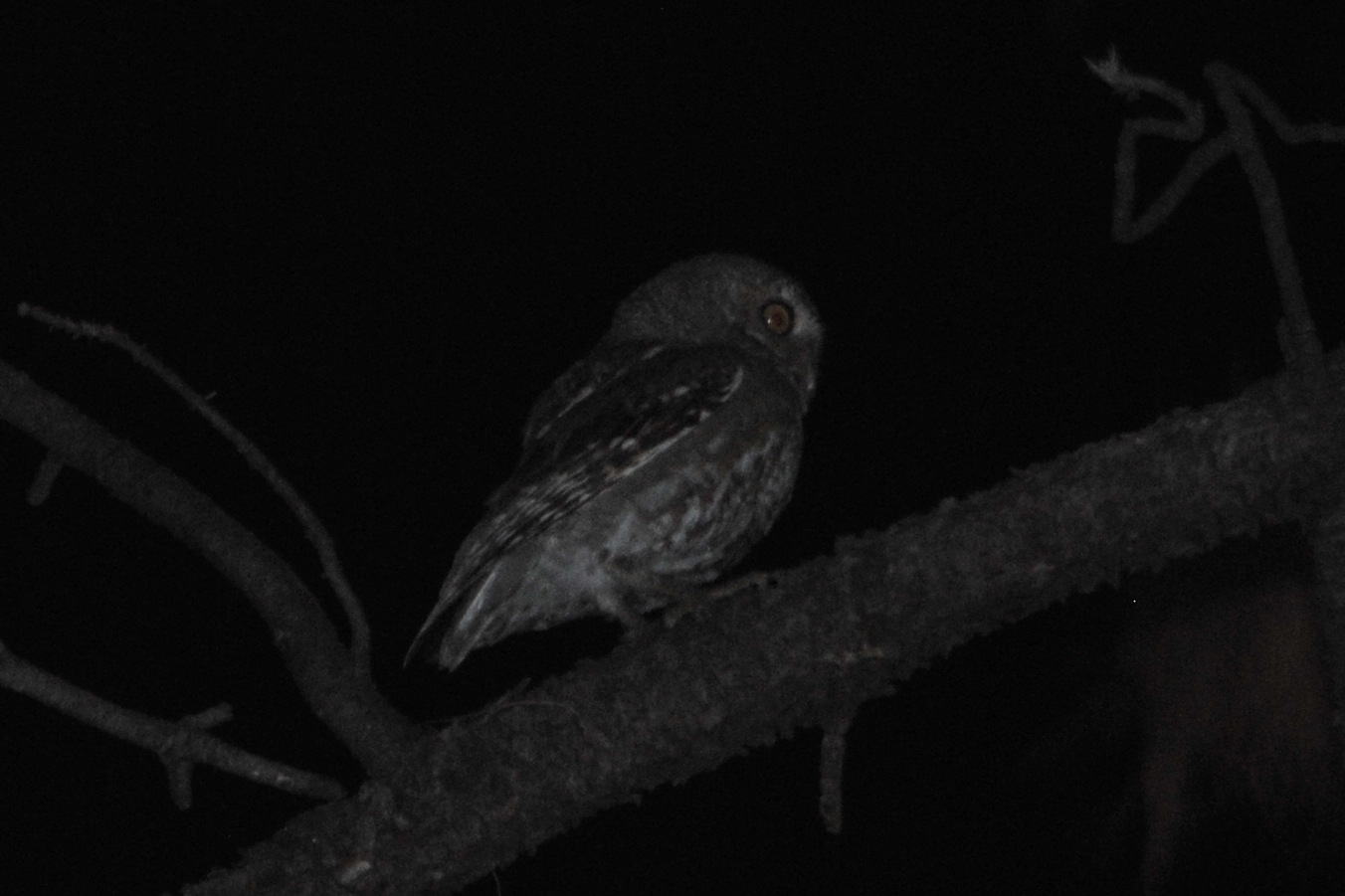
Elf Owl--In nesting cavity

The owling trip wasn't very long so Walker and I asked for permission to do a little owling afterwards and our permission was granted! So Walker and I owled around the Station for about forty-five minutes before we had to come back. We had two nocturnal targets for the trip, Whiskered Screech-Owl and Mexican Whip-poor-will. As we walked along the edge of a creek we were amazed to hear a Whiskered Screech-Owl give its descend "to to to to to to to to" call, Lifer #3 for the trip!!! We continued our owl excursion along the creek but the only other birds we could hear were a pair of Elf Owls laughing in the canopy of the tall sycamores. Before long it was time to go to sleep and then start a new day of birding. We started the next day early at 5:00 A.M. The first highlight was a calling Northern Pygmy-Owl that happened to be a lifer for Walker and only the second time for me. After hearing the owl it was time for breakfast. As soon as I was done eating I walked towards the feeders and was pumped to hear an Elegant Trogon calling from the creek! I quickly ran to get Walker and Dalton (Walker's younger brother) so we could possibly get a visual. While we were on our way to where I heard the trogon I spotted another lifer for Walker, a Northern Goshawk, flying low over the creek. After searching for the trogon without success we made our way to Cave Creek--South Fork, in hopes of seeing trogons. I don't know if you've noticed but it is hard enough trying to see a trogon by yourself but times that by 21 and you get stuck rubbing the belly of a rubber-chicken (you would have to be there to understand)! Of course the rubber-chicken didn't work and no trogons were seen, but while we were walking along the road I pointed out to an area that looked promising for a trogon to be nesting, and sure enough after walking past that area a trogon started calling from the exact patch of oaks I pointed to! There wasn't too much at the South Fork except for a brief glimpse of a Sulphur-bellied Flycatcher flying over. Our next stop was at Turkey Creek where Walker and I were hoping to get a Mexican Chickadee at but we of course came up empty. Our chances of getting the MECH started to thin out as we ran out of time but luckily our group's leaders decided to make one last stop at Rustler Park. The group said that we were only going to picnic at this area but Walker and I got permission from the leaders to go on birding hard while everyone ate lunch, we had one hour to find the Mexican Chickadee, one hour and that was it! So Walker and I hiked up the hillside (off trail) to a ridge where we listened for a while. While we were hiking along the ridge I heard a "chi chi" call that sounded good for MECH but it was so distant that it was hard to tell where it was coming from. We listened for about ten minutes without hearing the bird again until we decided to hike further along the ridge, then the bird called again only this time we both heard it! While we waited yet again for the bird to call I looked way out to where I had just seen a bird flitting around and once I put my binocs on it I saw that it was feeding and acting like a chickadee but it disappeared into the canopy of the firs. We walked over to where I saw it, I was frustrated to find no signs of any birds! But after about fifteen minutes of waiting I finally got a good look at that songster!

Mexican Chickadee!!!!!

After screaming "There it is!!!!!" Walker got on the bird and we nervously followed the bird hoping that it wouldn't fly away into the forest. As Walker and I observed the bird, it strangely hopped onto an odd perch, on a dead tree.


The Mexican Chickadees in the United States can only be found in two mountain ranges, the Chiricahua Mountains in southeastern Arizona and the Animas Mountains in Southwestern New Mexico. With the Chiris being the only place in AZ where you can find Mexican Chickadee a lot of birders come out to this mountain range just for that one bird! It was a huge relief for Walker and I to find this bird, and we definitely didn't hold out on the fist-bumps! It only got better when we found that there wasn't just one but two MECHs!


Walker then decided to go back to the group and tell them about our discovery while I stayed and watched the bird to make sure that it didn't go anywhere. While I watched the chickadee it strangely returned to the same dead tree that it came to earlier, that was when I noticed that it was bringing food to its nest that was in a cavity!!!

Mexican Chickadee--Bringing food to its fledglings!!!


Once Walker returned with the whole group I told them the good news and we had a memorable time of watching the chickadees go back-and-forth bringing food to their fledglings.

Waiting for the chickadee...   Photo by Ms. Jennie MacFarland

 To add onto the chickadee's awesomeness it was my 300th bird for the year! Even though it was hard to leave the chickadees, we had to go back to camp. Walker and I did even more birding while at camp, the only time that we weren't birding was when we were sleeping and sometimes when we were eating, but other than that we were birding HARD!!!! After birding, eating, and giving a short presentation we went on our second night of owling, only this time the only bird we heard was a Whiskered Screech-Owl that called once. So again we went out to do a little owling afterwards only this time it was Walker, Dalton, and I. A huge thanks to Ms. Jennie MacFarland for letting us borrow her speaker for bird calls! As we started owling we could hear the Whiskered still calling and soon after that we heard a pair of Elf Owls calling from close by and we even got a few photos!

Elf Owl


The Elf Owl is the smallest owl in the world and is only about the size of a chunky sparrow! This was only the second time I have seen the Elf so getting to photograph them on my second try was pretty cool. After heading back from the Elf Owl I decided to whistle the call of the Whiskered Screech-Owl out of my window and I had one react and several people got glimpses of it flying back-and-forth. I had an amazing first two days of the trip and the next day only got better! Stay Tuned to find out what I might see next.