Showing posts with label Mexican Chickadee. Show all posts

Friday, June 3, 2016

Birding Hard in SEAZ (Day 3)

Hoot...hoo hoo...hoo! Walker woke me up from a dream I had where a Spotted Owl was calling. A few seconds after being awakened I noticed what I heard wasn't a dream but a real Spotted Owl! What a way to start the day! Light started to brighten the morning sky as stars faded in the Chiricahua Mountains. Cordilleran Flycatchers and Great Horned Owls started calling both near and far. It was time to pack up camp. We had stuff to be done, like seeing Slate-throated Redstarts! As soon as we set up camp we drove a little ways up the road to where the redstart had been seen. We birded the drainage for about a half hour before it hit us that it was strange that we hadn't run into any birders. So when a car drove by and stopped we asked what was up and found that we were searching the wrong drainage! Walker had suspected this but the drainage that we were in seemed fitting for the description in past listserve reports. Embarrassingly, we ran back to our car and then drove over to where they had just seen the bird. Upon arriving, no one had seen the bird since 5:15 in the morning, while we were checking the false drainage. Now it didn't take much to see that Walker and Dalton were a bit disappointed in my major failure, so I knew I had to pay them back! After waiting around the Slate-throated Redstart's nest for over three hours our hopes of getting this bird started falling quickly. I decided that since there were quite a few birders watching the nesting area they likely wouldn't miss it without me, so I thought I'd check the surrounding area in hopes of finding it. Hiking up the drainage, I started pishing and doing my "Mountain" Northern Pygmy-Owl imitation whistle in hopes of bringing in a mixed feeding flock of birds. The first birds to come in were a pair of Mexican Chickadees!

Mexican Chickadee


Once the chickadees started scolding me a lot of other birds started coming in. First a pair of Painted Redstarts, then some Yellow-eyed Juncos, a Spotted Towhee, a Hammond's Flycatcher, a Townsend's Warbler, a Red-faced Warbler, and then WHAT?!?!?!?! THE SLATE-THROATED REDSTART!!!!!!!

Slate-throated Redstart

Once I spotted our bird I immediately started yelling "WALKER!!!". I had to hike a ways down the canyon to get to a point where anyone could hear me. A man came hiking up the drainage and right when I got him on the bird I sprinted down the steep hill jumping over dead logs, and sliding down the hillside until I got to Walker and Dalton. I yelled that I had the bird and once they came running I returned to the man who was still watching the bird!

Slate-throated Redstart


Walker and Dalton along with another nice birder came up the hill shortly behind me and I quickly got them on the bird. We were ecstatic about this find, adding to the sickening amount of icing on our birding cake! However, there were a few other birders down the hill coming up so I ran back down to them in an attempt to get them on the bird. Unfortunately, when I returned the bird was gone never to be seen again. We didn't stick around for long after we lost the bird, because, we had other spots to hit before the day ended. Our next spot we hit was the Southwestern Research Center where we had plans to watch the feeders. On our way to the research center we were stopped by the birders who we ran into earlier and they told us that  they just had an American Redstart at the Southwestern Research Center!!! The three of us were pumped at the thought of having a triple redstart day!!! With even more determination, we zoomed on over to the research center where we were greeted by a few Blue-throated Hummingbirds!

Blue-throated Hummingbird

While we were watching the hummingbirds Walker spotted out third redstart of the day, an adult female American Redstart, bringing us up to a triple redstart hour!!!

American Redstart


The American Redstart was a lifer for Dalton so that was very cool! We decided to photograph a nearby Painted Redstart just to show you three redstart species in a single post.

Painted Redstart

A super tame Western Wood-Pewee was quite cool to see as well!

Western Wood-Pewee


From the Chiricahuas we drove on over to the Santa Ritas where we'd stay the night near Madera Canyon. The Plain-capped Starthroat was still being seen from time to time at the Santa Rita Lodge and I really wanted that bird! So our first and only stop in Madera Canyon for the day was, of course, the Santa Rita Lodge. We scanned the feeders for a good two and a half hours before darkness fell. Although we didn't see any rare hummingbirds I did get my photo-lifer Sulphur-bellied Flycatcher which was nice.

Suphur-bellied Flycatcher

Once darkness fell we were excited for another great night of owling! The first nocturnal birds to start calling were the Mexican Whip-poor-wills and Whiskered Screech-Owls.

Whiskered Screech-Owl

Owls were less vocal in the upper portion of the canyon then our previous owling trip so we decided to hit the lower elevations where the trees were shorter and the owls were plenty! Seeing a Whiskered Screech-Owl calling from a telephone wire was something I never thought I'd see!

Whiskered Screech-Owl

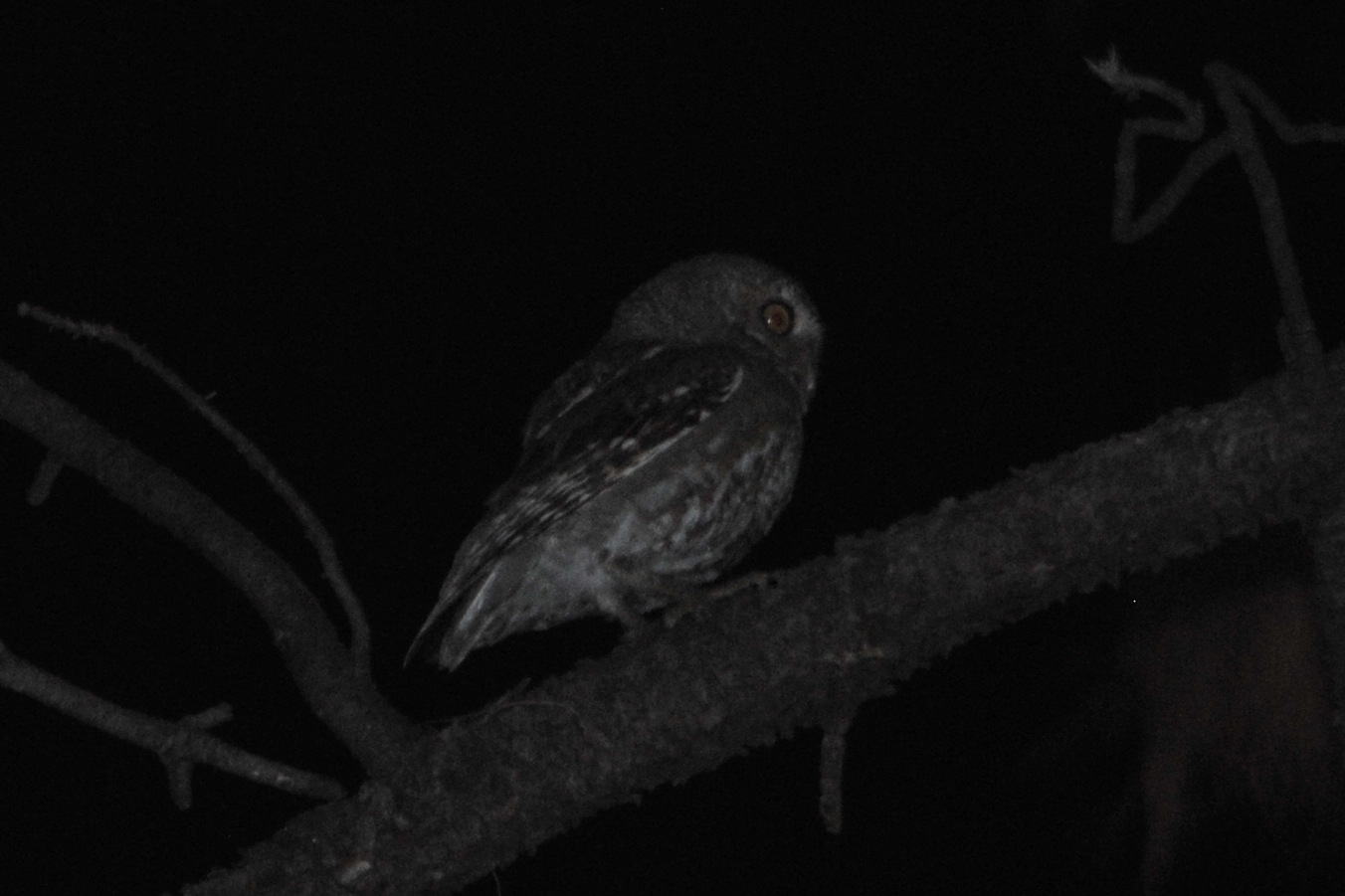
While I was following the Whiskered Screech-Owls around I heard an Elf Owl calling from fairly close so I put my flashlight on where the sound was coming from and was surprised to spot an Elf on a perfect perch!

Elf Owl


Although I should have been able to get way better crushes than what I got this was my first time crushing ELOW so I was content with what I got. We then drove down even lower in elevation to Proctor road where we spent the night. While we were setting up our tent we heard a Western Screech-Owl calling in the distance. Walker and I knew it wasn't only mid-night but it was crush-night!!! After tracking down where the owl was calling from we spotted our 10th owl of our trip, a beautiful female Western Screech-Owl!

Western Screech-Owl

This Western Screech-Owl was the most cooperative owl I have ever encountered in the wild! It was fearless and allowed us to get within less than four feet away from her as she stood less than four feet above the ground!

Western Screech-Owl


A question I commonly get asked his how to identify Western and Whiskered Screech-Owls apart. Here are a few different ways for telling them apart.

1. Common calls: Western gives a bouncing-ball song of fairly deep hoots. Another call which Western frequently gives (mostly in response to its own call) is a trill of hoots Here is a recording with both the bouncing-ball call and the trill WESO call. Whiskered, on the other hand, gives a descending serous of hoots lowering in pitch (listen here) along with a mores-code-like song of fairly high-pitched hoots (listen here). Whiskered also gives a barking contact call which is sometime mistaken for the barking call of the Spotted Owl (listen here)

2. Identification by sight: In my experience, Western has a black, or at least, mostly black bill as where Whiskered has a greenish bill. Western also seems to have large while Whiskered has small feet. The streaking pattern on the front of both birds is different too. I have also noticed that Whiskered seems to have a lighter gray belly than Western. I have noticed some difference in the eyes but I'm not sure if that is, at all, reliable. Whiskered seems to have a smaller body in proportion to its head than Western does too. Here are a couple photos bellow to help you see the differences between these two similar species.

Whiskered Screech-Owl (left) and Western Screech-Owl (right)

 I ended the day with one lifer which was more than enough, considering it was a code 4! We still had one more half-day left and it would be spent sitting at the Santa Rita Lodge waiting for the starthroat to come in. Stay tuned to read how my last day in SEAZ ended!

Thursday, June 18, 2015

My First Young Birder's Camp-- The Chiricahua's (Part 1)

A few months ago I was informed that on the AZNM Listserve there was going to be a young birder's camp to the Chiricahua Mountains in SEAZ, of course I jumped at the opportunity and thanks to Mr. Tom Hildebrandt, Mr. Joe Ford, and my parents I was able to go! I haven't ever been to a young birder's camp or the to the Chiricahuas, so this was kinda like killing two birds with one stone (no birds were harmed in the making of this post). Well on June 12th I was headed up towards Wilcox with Mr. Ford, where we would meet up with the rest of the camp. The night before the trip we had plans to chase an Elegant Tern in Tucson before going to Wilcox but of course when we were almost to Tuscon I looked on the listserve to see that the tern had just left!!! After laughing about the report we had to make a quick change of plans, so we instead decided to bird around St. David which is just south of Benson. Our target bird for this area was the Mississippi Kite which can be seen in fairly good numbers in this area. Once Mr. Ford and I arrived at the St. David Holy Trinity we started birding and it wasn't long before Mr. Ford and I found a couple of Tropical Kingbirds.

Tropical Kingbird

While Mr. Ford watched some of his favorite birds like Northern Cardinals, Bullock's Orioles, Vermilion Flycatchers, Yellow Warblers, and Phainopeplas I kept my eyes in the skies for any kites. After birding the area for nearly forty-five minutes it was time to leave but just as we were getting into the car to leave I spied a super distant raptor and once I lifted my binocs onto the bird I was pumped to find that it was my buzzer-beating Mississippi Kite swooping down into the riparian forest! I was ecstatic to see a lifer before the camp even started! We then made our way over to Wilcox where we met up with the other birders before the camp I kept in touch with Walker Noe (who was my roommate during the camp), and before I even met him I knew that we were going to be what we called "A one-two punch of awesomeness"! Walker and I had six main target birds for the trip: Blue-throated Hummingbird, Scaled Quail, Mexican Whip-poor-will, Whiskered Screech-Owl, Buff-breasted Flycatcher, and our most sought after target of the trip, the Mexican Chickadee! Before we headed over to the Southwestern Research Station where we were staying, we made a quick stop by Rustler Park (an area known for getting MECHs at). The area had a few birds like these Yellow-eyed Juncos.
Yellow-eyed Junco


After the short stop by Rustler we made our way to the Station, where Walker and I walked down to the hummingbird feeders where we saw our first target of the trip, the Blue-throated Hummingbird.

Blue-throated Hummingbird--male


Blue-throated Hummingbird--female


Walker and I spent a lot of time during camp at the hummingbird feeders in search of the best photo opportunity or a Plain-capped Starthroat (guess which one we got). Magnificent Hummingbirds (like the Blue-throats) are quite numerous around the feeders.

Magnificent Hummingbird--male


Magnificent Hummingbird--female

After the hummingbirds, we explored some of the nearby drainages in search of any Buff-breasted Flycatchers. Spoiler-alert, we didn't find any BBFLs during the whole trip even after searching several drainages many times! After a little more birding we made our first owling trip to a nearby home. Even though we had a group of over twenty people we made it work, somehow. While we stood in the day  I looked up in the night sky and spotted an Elf Owl! Mr. John Yerger (the owl master) said that he didn't want us using flash photography, which is nearly impossibly at night time so this was the most that I could manage.

Elf Owl--In nesting cavity

The owling trip wasn't very long so Walker and I asked for permission to do a little owling afterwards and our permission was granted! So Walker and I owled around the Station for about forty-five minutes before we had to come back. We had two nocturnal targets for the trip, Whiskered Screech-Owl and Mexican Whip-poor-will. As we walked along the edge of a creek we were amazed to hear a Whiskered Screech-Owl give its descend "to to to to to to to to" call, Lifer #3 for the trip!!! We continued our owl excursion along the creek but the only other birds we could hear were a pair of Elf Owls laughing in the canopy of the tall sycamores. Before long it was time to go to sleep and then start a new day of birding. We started the next day early at 5:00 A.M. The first highlight was a calling Northern Pygmy-Owl that happened to be a lifer for Walker and only the second time for me. After hearing the owl it was time for breakfast. As soon as I was done eating I walked towards the feeders and was pumped to hear an Elegant Trogon calling from the creek! I quickly ran to get Walker and Dalton (Walker's younger brother) so we could possibly get a visual. While we were on our way to where I heard the trogon I spotted another lifer for Walker, a Northern Goshawk, flying low over the creek. After searching for the trogon without success we made our way to Cave Creek--South Fork, in hopes of seeing trogons. I don't know if you've noticed but it is hard enough trying to see a trogon by yourself but times that by 21 and you get stuck rubbing the belly of a rubber-chicken (you would have to be there to understand)! Of course the rubber-chicken didn't work and no trogons were seen, but while we were walking along the road I pointed out to an area that looked promising for a trogon to be nesting, and sure enough after walking past that area a trogon started calling from the exact patch of oaks I pointed to! There wasn't too much at the South Fork except for a brief glimpse of a Sulphur-bellied Flycatcher flying over. Our next stop was at Turkey Creek where Walker and I were hoping to get a Mexican Chickadee at but we of course came up empty. Our chances of getting the MECH started to thin out as we ran out of time but luckily our group's leaders decided to make one last stop at Rustler Park. The group said that we were only going to picnic at this area but Walker and I got permission from the leaders to go on birding hard while everyone ate lunch, we had one hour to find the Mexican Chickadee, one hour and that was it! So Walker and I hiked up the hillside (off trail) to a ridge where we listened for a while. While we were hiking along the ridge I heard a "chi chi" call that sounded good for MECH but it was so distant that it was hard to tell where it was coming from. We listened for about ten minutes without hearing the bird again until we decided to hike further along the ridge, then the bird called again only this time we both heard it! While we waited yet again for the bird to call I looked way out to where I had just seen a bird flitting around and once I put my binocs on it I saw that it was feeding and acting like a chickadee but it disappeared into the canopy of the firs. We walked over to where I saw it, I was frustrated to find no signs of any birds! But after about fifteen minutes of waiting I finally got a good look at that songster!

Mexican Chickadee!!!!!

After screaming "There it is!!!!!" Walker got on the bird and we nervously followed the bird hoping that it wouldn't fly away into the forest. As Walker and I observed the bird, it strangely hopped onto an odd perch, on a dead tree.


The Mexican Chickadees in the United States can only be found in two mountain ranges, the Chiricahua Mountains in southeastern Arizona and the Animas Mountains in Southwestern New Mexico. With the Chiris being the only place in AZ where you can find Mexican Chickadee a lot of birders come out to this mountain range just for that one bird! It was a huge relief for Walker and I to find this bird, and we definitely didn't hold out on the fist-bumps! It only got better when we found that there wasn't just one but two MECHs!


Walker then decided to go back to the group and tell them about our discovery while I stayed and watched the bird to make sure that it didn't go anywhere. While I watched the chickadee it strangely returned to the same dead tree that it came to earlier, that was when I noticed that it was bringing food to its nest that was in a cavity!!!

Mexican Chickadee--Bringing food to its fledglings!!!


Once Walker returned with the whole group I told them the good news and we had a memorable time of watching the chickadees go back-and-forth bringing food to their fledglings.

Waiting for the chickadee...   Photo by Ms. Jennie MacFarland

 To add onto the chickadee's awesomeness it was my 300th bird for the year! Even though it was hard to leave the chickadees, we had to go back to camp. Walker and I did even more birding while at camp, the only time that we weren't birding was when we were sleeping and sometimes when we were eating, but other than that we were birding HARD!!!! After birding, eating, and giving a short presentation we went on our second night of owling, only this time the only bird we heard was a Whiskered Screech-Owl that called once. So again we went out to do a little owling afterwards only this time it was Walker, Dalton, and I. A huge thanks to Ms. Jennie MacFarland for letting us borrow her speaker for bird calls! As we started owling we could hear the Whiskered still calling and soon after that we heard a pair of Elf Owls calling from close by and we even got a few photos!

Elf Owl


The Elf Owl is the smallest owl in the world and is only about the size of a chunky sparrow! This was only the second time I have seen the Elf so getting to photograph them on my second try was pretty cool. After heading back from the Elf Owl I decided to whistle the call of the Whiskered Screech-Owl out of my window and I had one react and several people got glimpses of it flying back-and-forth. I had an amazing first two days of the trip and the next day only got better! Stay Tuned to find out what I might see next.