House Wren

The higher elevations of Slate Creek, Mt. Ord, and a few other areas in the Mazatzal Mountains are the only places in Maricopa County where House Wrens can be found breeding at.
Blue-gray Gnatcatcher

Black-throated Gray Warbler

Bushtit

Pygmy Nuthatch

Like the lower slopes, this area is also quite similar to Mt. Ord's 1688 Trail only smaller and a lot steeper. Exploring new areas is always a treat and it only adds to its fun when it happens to be one of the top ten birding spots in the county! Once we started heading back Mr. Troy and I spotted a couple of jays that flew across the road and into a tall pine, and that was when I started celebrating!
Mexican Jay--#300 for Maicopa County!!!!


I was more pumped getting this bird as #300 for Maricopa County then I was when I first saw this bird as a lifer! Now comes #400 for the county, but I will be satisfied 350. Once I was done enjoying my milestone bird we started driving towards the end of the road where it meets up with the Arizona Trail and a drainage that we call Drainage A, but before we get that far ahead lets enjoy a couple more of the unique breeding birds of Slate Creek.
Western Tanager

Northern Flicker

Mr. Troy and I then drove over to what would be the best spot of the day, the drainages. Even though the two drainages (Drainage A and Drainage B) are the best places to go birding at Slate Creek they are also the most dangerous and I and many other birders highly recommend to never bird this area alone. The drainage has many Black-tailed and Arizona Black Rattlesnakes, has a few Black Bears and Mountain Lions, it can be a fairly steep hike, has a lot of poison-ivy, and has no cellphone reception. In order to bird this area it also takes minor rock-climbing and bush-whacking. But if you know what you're doing and bird with another person I highly recommend birding this area, because it is amazing! So you have an idea of what the area looks like, here is a map of the two drainages from Mr. Tommy's website birderfrommaricopa.
Courtesy of Tommy DeBardeleben

The thick white line shows forest road 201, the thin white line shows the Arizona trail, the thin blue-green line shows the Maricopa/Gila County lines, the thick green line shows Drainage A, and the orange line shows Drainage B (which is the roughest hike).
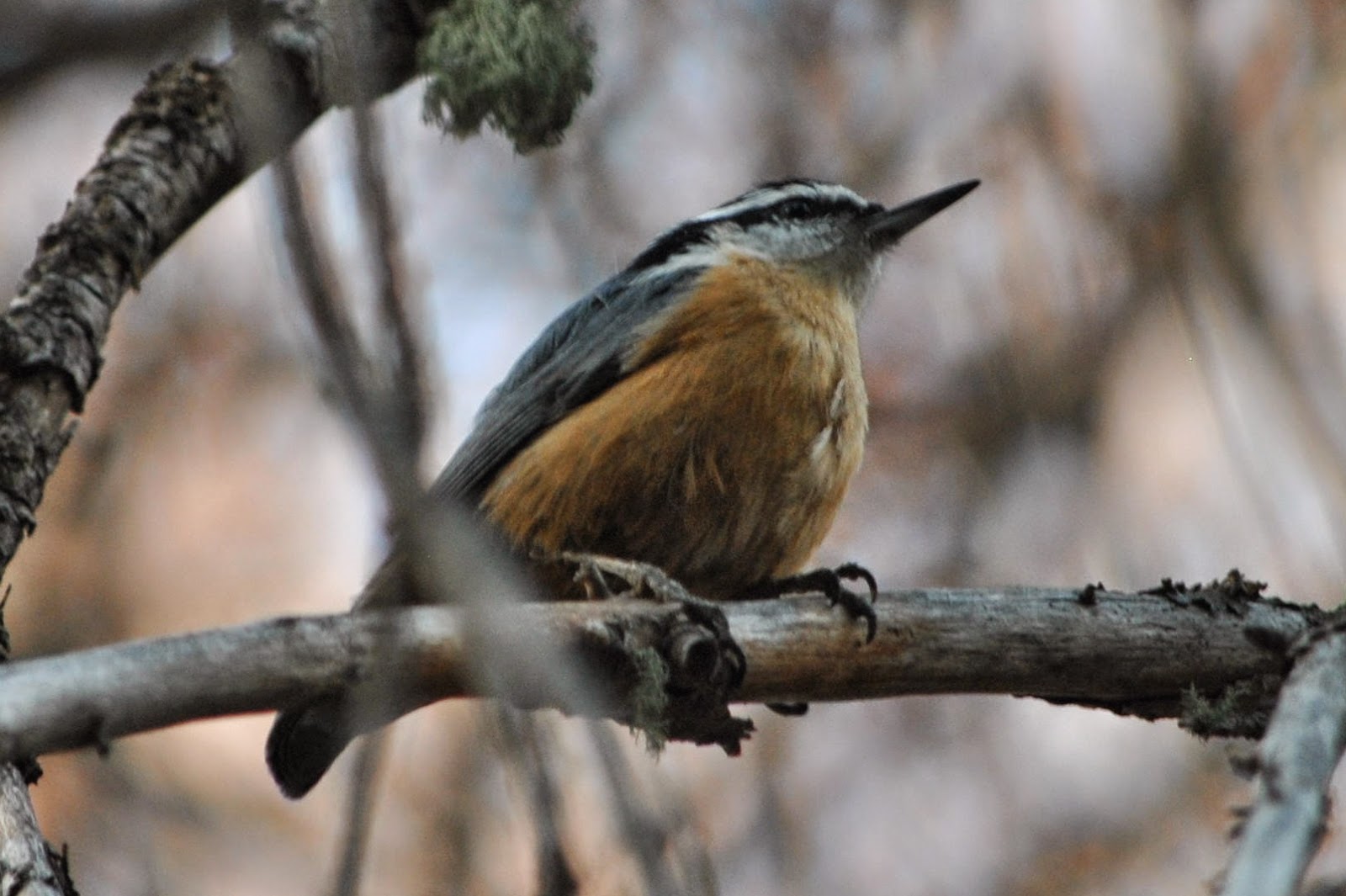
My target bird for this area was the Dusky-capped Flycatchers which breed at the intersection of the two drainages and along Drainage B. It has been a while since Red-faced Warblers have bred at this spot but the habitat in these drainages have nearly a perfect habitat for this species and I think that it will only be in the next few years before this beautiful mountain-loving bird comes back. The Red-breasted Nuthatch was one of my minor target birds for this trip too, because I have only seen it once in the county and it is just an overall great bird. It didn't take us long to locate a few RBNUs.
Red-breasted Nuthatch


Out of the three nuthatches found in AZ (Pygmy, White-breasted, and Red-breasted) my favorite would have to be the Pygmy, but the Red-breasted is a close 2nd. When it comes to sound, however, the Red-breasted takes the cake, with its nasal-trumpet call that can often be heard in Douglas-fir forests. One of the most confusing and confused birds we encountered was a Lucy's Warbler! I never thought I would see this species singing in a Douglas-fir but hey I'll take it! Mr. Troy and I were confused as to why this bird was in this habitat because it is one of our first migrants arriving by mid March and breeding by late April to early May, so I asked Mr. Troy to play the Lucy's Warbler song from his phone to see if the bird would respond in being territorial but it didn't! Mr. Troy explained that it was probably better that the bird didn't spread its genes, because we don't want a confused population of Douglas-fir breeding Lucy's Warblers. I know this photo will probably ruin the this whole post but I will put it in just for memories.
One confused Lucy's Warbler!

Once we reached the intersection of the two drainages it didn't take us long to find at least one pair of Dusky-capped Flycatchers giving their mournful calls.
Dusky-capped Flycatcher


The Dusky-capped Flycatcher breeds at only two or three spots in the county, and they'll even skip breeding at Slate Creek every once in a while. The DCFL wasn't even detected at Slate Creek until about 2010. Birders are probably the only people who will get excited to hear such a mournful and depressing whistle. After watching the flycatchers for a while we then did a little more hiking up and down part of Drainage B before eating lunch. By the the time we started eating lunch things had started to quiet down a lot but drumming Hairy Woodpeckers livened things up a little. Once we were done eating lunch we then started our hike back when Mr. Troy spied a Gambel's White-crowned Sparrow from only a few feet away before we ended the day.
White-crowned Sparrow

Note the white/gray lores (the feathers between its bill and eye) distinguishing it from the Mountain White-crowned Sparrow, who's lores are black. All of the Gambel's should be gone by now with the Mountain being the later migrant but this bird must have had something wrong with it.
But wait! I saved the best for last. In between seeing my Maricoper Mexican Jays and Dusky-capped Flycatchers I found what was even better than the two combined! I can't give the location of the bird but all I can say is that it was on the Maricopa side of Slate Creek Divide. Here is what happened............
While Mr. Troy and I called for Northern Pygmy-Owls I happened to look up on the hillside when I spotted a blob up in a shady oak. This is what it looked like though my eyes, can you find it?

Right when I saw it I knew that it was an owl but I have seen lots of Great Horned Owls do the same thing, so I lifted my binocs up and yelled Spotted Owl!!!!!


Right when I saw it I knew that it was an owl but I have seen lots of Great Horned Owls do the same thing, so I lifted my binocs up and yelled Spotted Owl!!!!!
Spotted Owl!!!

I was shocked to find that it was a Spotted Owl only about sixty yards from where we were, and we almost passed it! Here is a photo from Mr. Tommy's blog that shows just how hard of a time this owl gives birders.

I then hiked a little ways up the side of the hill and got better views.

Photo courtesy of Tommy D

Spotted Owl

We observed the SPOW for about ten minutes before moving on and during that time frame I couldn't believe that I was staring at a Spotted Owl in my home county of Maricopa, the same county that reaches 115 degrees in the Summer and holds the city of Phoenix! While we watched the owl a Broad-tailed Hummingbird came in and started pestering the pore thing.

Here is a photo that Mr. Troy took of me with the spotty.

Reaching 300 species of bird for my home county of Maricopa was a nice milestone to reach! With Mexican Jay being #300, Spotted Owl #301, and Dusky-capped Flycatcher #302 I still have a long way to go before reaching 400! But I'm only fifteen years old so I have a lot of time to reach my goal. Thanks Mr. Troy for the awesome day of birding and exploring a new area with me!
Spotted Owl with Broad-tailed Hummingbird

Here is a photo that Mr. Troy took of me with the spotty.

Reaching 300 species of bird for my home county of Maricopa was a nice milestone to reach! With Mexican Jay being #300, Spotted Owl #301, and Dusky-capped Flycatcher #302 I still have a long way to go before reaching 400! But I'm only fifteen years old so I have a lot of time to reach my goal. Thanks Mr. Troy for the awesome day of birding and exploring a new area with me!