Thursday, June 18, 2015

My First Young Birder's Camp-- The Chiricahua's (Part 1)

A few months ago I was informed that on the AZNM Listserve there was going to be a young birder's camp to the Chiricahua Mountains in SEAZ, of course I jumped at the opportunity and thanks to Mr. Tom Hildebrandt, Mr. Joe Ford, and my parents I was able to go! I haven't ever been to a young birder's camp or the to the Chiricahuas, so this was kinda like killing two birds with one stone (no birds were harmed in the making of this post). Well on June 12th I was headed up towards Wilcox with Mr. Ford, where we would meet up with the rest of the camp. The night before the trip we had plans to chase an Elegant Tern in Tucson before going to Wilcox but of course when we were almost to Tuscon I looked on the listserve to see that the tern had just left!!! After laughing about the report we had to make a quick change of plans, so we instead decided to bird around St. David which is just south of Benson. Our target bird for this area was the Mississippi Kite which can be seen in fairly good numbers in this area. Once Mr. Ford and I arrived at the St. David Holy Trinity we started birding and it wasn't long before Mr. Ford and I found a couple of Tropical Kingbirds.

Tropical Kingbird

While Mr. Ford watched some of his favorite birds like Northern Cardinals, Bullock's Orioles, Vermilion Flycatchers, Yellow Warblers, and Phainopeplas I kept my eyes in the skies for any kites. After birding the area for nearly forty-five minutes it was time to leave but just as we were getting into the car to leave I spied a super distant raptor and once I lifted my binocs onto the bird I was pumped to find that it was my buzzer-beating Mississippi Kite swooping down into the riparian forest! I was ecstatic to see a lifer before the camp even started! We then made our way over to Wilcox where we met up with the other birders before the camp I kept in touch with Walker Noe (who was my roommate during the camp), and before I even met him I knew that we were going to be what we called "A one-two punch of awesomeness"! Walker and I had six main target birds for the trip: Blue-throated Hummingbird, Scaled Quail, Mexican Whip-poor-will, Whiskered Screech-Owl, Buff-breasted Flycatcher, and our most sought after target of the trip, the Mexican Chickadee! Before we headed over to the Southwestern Research Station where we were staying, we made a quick stop by Rustler Park (an area known for getting MECHs at). The area had a few birds like these Yellow-eyed Juncos.
Yellow-eyed Junco


After the short stop by Rustler we made our way to the Station, where Walker and I walked down to the hummingbird feeders where we saw our first target of the trip, the Blue-throated Hummingbird.

Blue-throated Hummingbird--male


Blue-throated Hummingbird--female


Walker and I spent a lot of time during camp at the hummingbird feeders in search of the best photo opportunity or a Plain-capped Starthroat (guess which one we got). Magnificent Hummingbirds (like the Blue-throats) are quite numerous around the feeders.

Magnificent Hummingbird--male


Magnificent Hummingbird--female

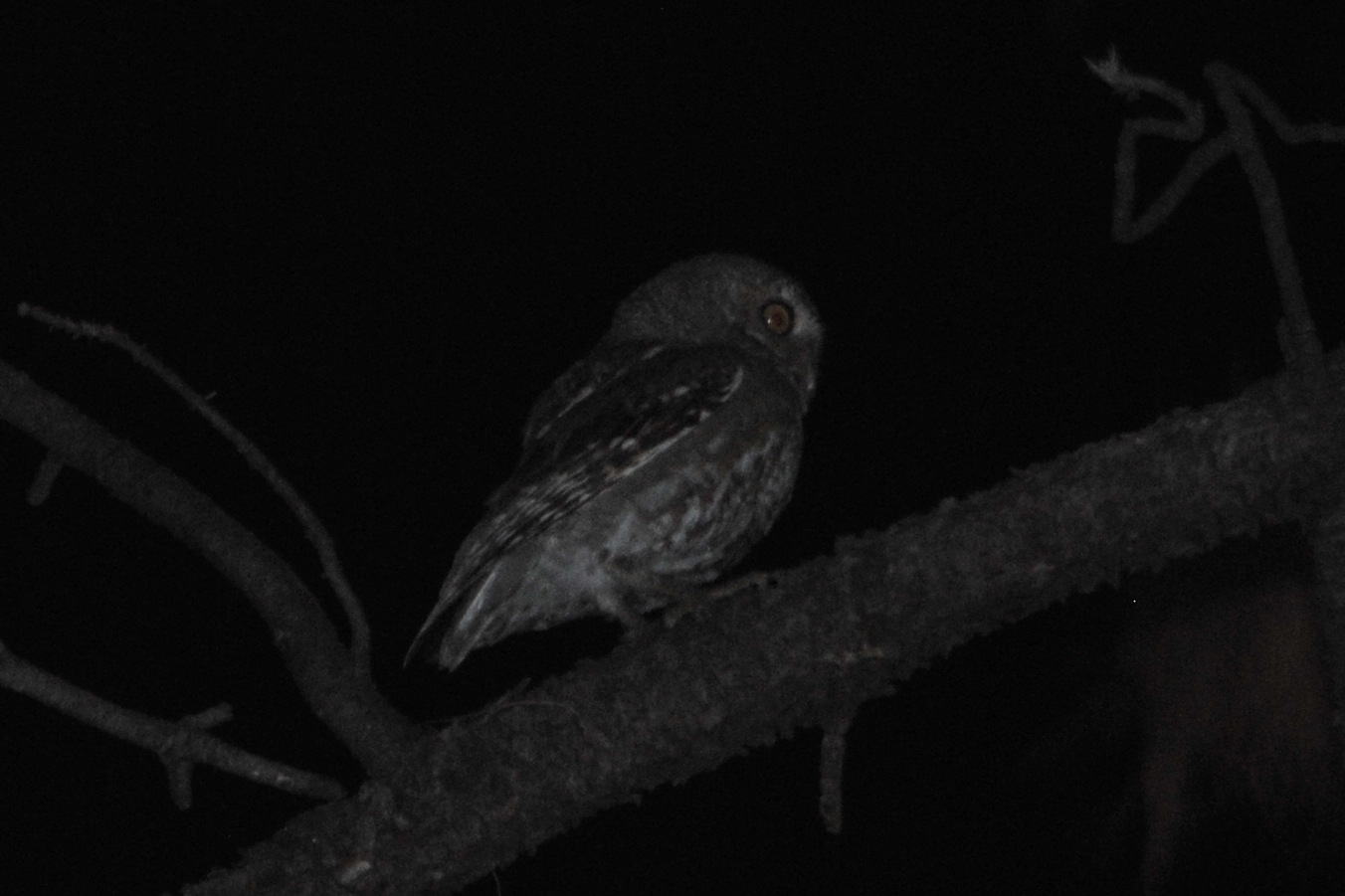
After the hummingbirds, we explored some of the nearby drainages in search of any Buff-breasted Flycatchers. Spoiler-alert, we didn't find any BBFLs during the whole trip even after searching several drainages many times! After a little more birding we made our first owling trip to a nearby home. Even though we had a group of over twenty people we made it work, somehow. While we stood in the day  I looked up in the night sky and spotted an Elf Owl! Mr. John Yerger (the owl master) said that he didn't want us using flash photography, which is nearly impossibly at night time so this was the most that I could manage.

Elf Owl--In nesting cavity

The owling trip wasn't very long so Walker and I asked for permission to do a little owling afterwards and our permission was granted! So Walker and I owled around the Station for about forty-five minutes before we had to come back. We had two nocturnal targets for the trip, Whiskered Screech-Owl and Mexican Whip-poor-will. As we walked along the edge of a creek we were amazed to hear a Whiskered Screech-Owl give its descend "to to to to to to to to" call, Lifer #3 for the trip!!! We continued our owl excursion along the creek but the only other birds we could hear were a pair of Elf Owls laughing in the canopy of the tall sycamores. Before long it was time to go to sleep and then start a new day of birding. We started the next day early at 5:00 A.M. The first highlight was a calling Northern Pygmy-Owl that happened to be a lifer for Walker and only the second time for me. After hearing the owl it was time for breakfast. As soon as I was done eating I walked towards the feeders and was pumped to hear an Elegant Trogon calling from the creek! I quickly ran to get Walker and Dalton (Walker's younger brother) so we could possibly get a visual. While we were on our way to where I heard the trogon I spotted another lifer for Walker, a Northern Goshawk, flying low over the creek. After searching for the trogon without success we made our way to Cave Creek--South Fork, in hopes of seeing trogons. I don't know if you've noticed but it is hard enough trying to see a trogon by yourself but times that by 21 and you get stuck rubbing the belly of a rubber-chicken (you would have to be there to understand)! Of course the rubber-chicken didn't work and no trogons were seen, but while we were walking along the road I pointed out to an area that looked promising for a trogon to be nesting, and sure enough after walking past that area a trogon started calling from the exact patch of oaks I pointed to! There wasn't too much at the South Fork except for a brief glimpse of a Sulphur-bellied Flycatcher flying over. Our next stop was at Turkey Creek where Walker and I were hoping to get a Mexican Chickadee at but we of course came up empty. Our chances of getting the MECH started to thin out as we ran out of time but luckily our group's leaders decided to make one last stop at Rustler Park. The group said that we were only going to picnic at this area but Walker and I got permission from the leaders to go on birding hard while everyone ate lunch, we had one hour to find the Mexican Chickadee, one hour and that was it! So Walker and I hiked up the hillside (off trail) to a ridge where we listened for a while. While we were hiking along the ridge I heard a "chi chi" call that sounded good for MECH but it was so distant that it was hard to tell where it was coming from. We listened for about ten minutes without hearing the bird again until we decided to hike further along the ridge, then the bird called again only this time we both heard it! While we waited yet again for the bird to call I looked way out to where I had just seen a bird flitting around and once I put my binocs on it I saw that it was feeding and acting like a chickadee but it disappeared into the canopy of the firs. We walked over to where I saw it, I was frustrated to find no signs of any birds! But after about fifteen minutes of waiting I finally got a good look at that songster!

Mexican Chickadee!!!!!

After screaming "There it is!!!!!" Walker got on the bird and we nervously followed the bird hoping that it wouldn't fly away into the forest. As Walker and I observed the bird, it strangely hopped onto an odd perch, on a dead tree.


The Mexican Chickadees in the United States can only be found in two mountain ranges, the Chiricahua Mountains in southeastern Arizona and the Animas Mountains in Southwestern New Mexico. With the Chiris being the only place in AZ where you can find Mexican Chickadee a lot of birders come out to this mountain range just for that one bird! It was a huge relief for Walker and I to find this bird, and we definitely didn't hold out on the fist-bumps! It only got better when we found that there wasn't just one but two MECHs!


Walker then decided to go back to the group and tell them about our discovery while I stayed and watched the bird to make sure that it didn't go anywhere. While I watched the chickadee it strangely returned to the same dead tree that it came to earlier, that was when I noticed that it was bringing food to its nest that was in a cavity!!!

Mexican Chickadee--Bringing food to its fledglings!!!


Once Walker returned with the whole group I told them the good news and we had a memorable time of watching the chickadees go back-and-forth bringing food to their fledglings.

Waiting for the chickadee...   Photo by Ms. Jennie MacFarland

 To add onto the chickadee's awesomeness it was my 300th bird for the year! Even though it was hard to leave the chickadees, we had to go back to camp. Walker and I did even more birding while at camp, the only time that we weren't birding was when we were sleeping and sometimes when we were eating, but other than that we were birding HARD!!!! After birding, eating, and giving a short presentation we went on our second night of owling, only this time the only bird we heard was a Whiskered Screech-Owl that called once. So again we went out to do a little owling afterwards only this time it was Walker, Dalton, and I. A huge thanks to Ms. Jennie MacFarland for letting us borrow her speaker for bird calls! As we started owling we could hear the Whiskered still calling and soon after that we heard a pair of Elf Owls calling from close by and we even got a few photos!

Elf Owl


The Elf Owl is the smallest owl in the world and is only about the size of a chunky sparrow! This was only the second time I have seen the Elf so getting to photograph them on my second try was pretty cool. After heading back from the Elf Owl I decided to whistle the call of the Whiskered Screech-Owl out of my window and I had one react and several people got glimpses of it flying back-and-forth. I had an amazing first two days of the trip and the next day only got better! Stay Tuned to find out what I might see next.

Friday, June 5, 2015

Slate Creek Divide--The Trek for #300 Continues!!!

Slate Creek Divide is located in the extreme northeastern corner of Maricopa County. In the past, this area has had a couple of devastating fires and has lost some of its breeding birds like Red-faced Warbler, Mexican Whip-poor-pill, etc. But luckily there are a few areas on the Maricopa side of Slate Creek that haven't been burned, like a few drainage's that hold great forested habitat that almost resemble the mountains of southeastern Arizona. In the past fellow birder Mr. Tommy DeBardeleben has explored the drainages quite often, and in those searches has found Mexican Jays, Dusky-capped Flycatchers, a migrant Red-faced Warbler, a Flamulated Owl, and even a pair of Spotted Owls that took him over ten trips to finally find. However, many birders have gone out here several times in search of the Spotted Owl's day roost without success, as a matter of fact only a hand-full of people (mostly Spotted Owl researchers) have been able to find any Spotted Owl day roosts in Maricopa County. But when I made plans to bird this area on May 25th with Mr. Troy Corman I had what seemed like no more than the dream of being one of the firsts. Other than Mt. Ord I have not been able to bird at any of the other mountainous regions in Maricopa County, and just the mere thought of birding a new area is awesome! I had two target birds for this trip: Mexican Jay and Dusky-capped Flycatcher. I have seen both of these species before in southeastern Arizona but I haven't seen them anywhere away from that area. The lower elevations of Slate Creek are a lot like the lower slopes of Mt. Ord, holding breeding birds like Black-chinned and Rufous-crowned Sparrows, Black-headed Grosbeaks, Gray Vireos, Spotted and Canyon Towhees, Blue-gray Gnatcatchers, Bewick's Wrens and Bushtits. The main road that is taken to access Slate Creek is Forest Road 201 and Mr. Troy and my first stop was on a road that splits off of 201, called 201-A. This area has good pnderosa pine, evergreen oak, and a little Douglas-fir habitat, along with a lot of chaparral slopes. This is the same spot where Mr. Tommy had a Flamulated Owl calling last year. Mr. Troy and I hiked along the road pishing (bird calling) and giving our Northern Pygmy-Owl whistle imitation trying to call in whatever birds we could. The birds in Slate Creek reacted a lot more than they usually would due to it being breeding season. Here are some of the birds we called in.

House Wren
The higher elevations of Slate Creek, Mt. Ord, and a few other areas in the Mazatzal Mountains are the only places in Maricopa County where House Wrens can be found breeding at.

Blue-gray Gnatcatcher

Black-throated Gray Warbler

Bushtit

Pygmy Nuthatch

Like the lower slopes, this area is also quite similar to Mt. Ord's 1688 Trail only smaller and a lot steeper. Exploring new areas is always a treat and it only adds to its fun when it happens to be one of the top ten birding spots in the county! Once we started heading back Mr. Troy and I spotted a couple of jays that flew across the road and into a tall pine, and that was when I started celebrating!

Mexican Jay--#300 for Maicopa County!!!!


I was more pumped getting this bird as #300 for Maricopa County then I was when I first saw this bird as a lifer! Now comes #400 for the county, but I will be satisfied 350. Once I was done enjoying my milestone bird we started driving towards the end of the road where it meets up with the Arizona Trail and a drainage that we call Drainage A, but before we get that far ahead lets enjoy a couple more of the unique breeding birds of Slate Creek.

Western Tanager

Northern Flicker

Mr. Troy and I then drove over to what would be the best spot of the day, the drainages. Even though the two drainages (Drainage A and Drainage B) are the best places to go birding at Slate Creek they are also the most dangerous and I and many other birders highly recommend to never bird this area alone. The drainage has many Black-tailed and Arizona Black Rattlesnakes, has a few Black Bears and Mountain Lions, it can be a fairly steep hike, has a lot of poison-ivy, and has no cellphone reception. In order to bird this area it also takes minor rock-climbing and bush-whacking. But if you know what you're doing and bird with another person I highly recommend birding this area, because it is amazing! So you have an idea of what the area looks like, here is a map of the two drainages from Mr. Tommy's website birderfrommaricopa.

Courtesy of Tommy DeBardeleben
The thick white line shows forest road 201, the thin white line shows the Arizona trail, the thin blue-green line shows the Maricopa/Gila County lines, the thick green line shows Drainage A, and the orange line shows Drainage B (which is the roughest hike).

My target bird for this area was the Dusky-capped Flycatchers which breed at the intersection of the two drainages and along Drainage B. It has been a while since Red-faced Warblers have bred at this spot but the habitat in these drainages have nearly a perfect habitat for this species and I think that it will only be in the next few years before this beautiful mountain-loving bird comes back. The Red-breasted Nuthatch was one of my minor target birds for this trip too, because I have only seen it once in the county and it is just an overall great bird. It didn't take us long to locate a few RBNUs.

Red-breasted Nuthatch


Out of the three nuthatches found in AZ (Pygmy, White-breasted, and Red-breasted) my favorite would have to be the Pygmy, but the Red-breasted is a close 2nd. When it comes to sound, however, the Red-breasted takes the cake, with its nasal-trumpet call that can often be heard in Douglas-fir forests. One of the most confusing and confused birds we encountered was a Lucy's Warbler! I never thought I would see this species singing in a Douglas-fir but hey I'll take it! Mr. Troy and I were confused as to why this bird was in this habitat because it is one of our first migrants arriving by mid March and breeding by late April to early May, so I asked Mr. Troy to play the Lucy's Warbler song from his phone to see if the bird would respond in being territorial but it didn't! Mr. Troy explained that it was probably better that the bird didn't spread its genes, because we don't want a confused population of Douglas-fir breeding Lucy's Warblers. I know this photo will probably ruin the this whole post but I will put it in just for memories.

One confused Lucy's Warbler!

Once we reached the intersection of the two drainages it didn't take us long to find at least one pair of Dusky-capped Flycatchers giving their mournful calls.

Dusky-capped Flycatcher


The Dusky-capped Flycatcher breeds at only two or three spots in the county, and they'll even skip breeding at Slate Creek every once in a while. The DCFL wasn't even detected at Slate Creek until about 2010. Birders are probably the only people who will get excited to hear such a mournful and depressing whistle. After watching the flycatchers for a while we then did a little more hiking up and down part of Drainage B before eating lunch. By the the time we started eating lunch things had started to quiet down a lot but drumming Hairy Woodpeckers livened things up a little. Once we were done eating lunch we then started our hike back when Mr. Troy spied a Gambel's White-crowned Sparrow from only a few feet away before we ended the day.

White-crowned Sparrow
Note the white/gray lores (the feathers between its bill and eye) distinguishing it from the Mountain White-crowned Sparrow, who's lores are black. All of the Gambel's should be gone by now with the Mountain being the later migrant but this bird must have had something wrong with it.

But wait! I saved the best for last. In between seeing my Maricoper Mexican Jays and Dusky-capped Flycatchers I found what was even better than the two combined! I can't give the location of the bird but all I can say is that it was on the Maricopa side of Slate Creek Divide. Here is what happened............
While Mr. Troy and I called for Northern Pygmy-Owls I happened to look up on the hillside when I spotted a blob up in a shady oak. This is what it looked like though my eyes, can you find it?


Right when I saw it I knew that it was an owl but I have seen lots of Great Horned Owls do the same thing, so I lifted my binocs up and yelled Spotted Owl!!!!!

Spotted Owl!!!

I was shocked to find that it was a Spotted Owl only about sixty yards from where we were, and we almost passed it! Here is a photo from Mr. Tommy's blog that shows just how hard of a time this owl gives birders.

Photo courtesy of Tommy D

I then hiked a little ways up the side of the hill and got better views.

Spotted Owl

We observed the SPOW for about ten minutes before moving on and during that time frame I couldn't believe that I was staring at a Spotted Owl in my home county of Maricopa, the same county that reaches 115 degrees in the Summer and holds the city of Phoenix! While we watched the owl a Broad-tailed Hummingbird came in and started pestering the pore thing.

Spotted Owl with Broad-tailed Hummingbird

Here is a photo that Mr. Troy took of me with the spotty.


Reaching 300 species of bird for my home  county of Maricopa was a nice milestone to reach! With Mexican Jay being #300, Spotted Owl #301, and Dusky-capped Flycatcher #302 I still have a long way to go before reaching 400! But I'm only fifteen years old so I have a lot of time to reach my goal. Thanks Mr. Troy for the awesome day of birding and exploring a new area with me!