Thursday, May 7, 2015

Baseline and Meridian Wildlife Area

The Baseline and Meridian Wildlife Area is one of my favorite places to go when it comes to birding. "Why?" you might ask, well way back when I was a beginning birder I was introduced to this under-birded hotspot at a festival called "The Tres Rios Festival". Now don't let that name fool you, this is not the big Tres Rios site that you need a permit for, the B and M is about five miles west of Tres Rios. When I started birding around this area I was fortunate to be accompanied by Mr. Joe Ford, and we guided people around the marshy riparian area all day. That day I fell in love with this area! From then on I have been doing Important Bird Area (IBA) counts 3-5 times a year at the B and M. Away from IBA counts, I come to this spot anywhere from 12-22 times a year. The B and M has an amazing diversity of bird life. One of the most abundant habitats that the B and M offers is its marsh, which of course attracts large numbers of marsh birds. As a matter of fact, this very spot is one of the very few places in Maricopa County where you can find the endangered Yuma Ridgway's Rail. The marshy habitat also attracts large numbers of Virginia Rails, Soras, and Least Bitterns, it has also had American Bittern a few times! The second best habitat that the B and M offers are its many riparian stands of Fremont Cottonwoods and Goodding's Willows.

 Here is a map on how to get to the B and M from 91st Avenue, as well as another map of the B and M.

Map courtesy of Tommy DeBardeleben and Google

(The green highlighted path shows some of the trails, the car shows where to turn off, and the "P" stands for parking)

Here is one of the maps that I enhanced.

Below I explain what all of the colors are for.


Ridgway's Rail

Out of all of the awesome birds that can be observed at the B and M the most sought after would be the endangered yumanensis (Yuma) Ridgway's Rail. For those who are unfamiliar with the Clapper Rail split, the Clapper Rail was split into three species in 2014: Mangrove Rail which is found in Venezuela and Brazil, the Ridgway's Rail which is found from northern California down along the Colorado River, into a few spots along the Gila River and down along the Pacific Coast into Mexico, and the Clapper Rail who is found throughout the United States from Texas up to New York. The subspecies of Ridgway's Rail that is found in Arizona is the yuma or yumanensis which reaches its furthest west on the Salton Sea and goes as far east as the B and M. There are 2-4 pairs of RIRAs that breed at the B and M every year arriving by late March and staying until late September. The only pair that can be viewed without spending hours out, are seen along the tall bank which on the map is highlighted as a red trail, one must scan the reed-line often to make sure not to overlook any Ridgway's Rails or Virginia Rails, Soras, Least Bitterns, and possibly an American Bittern. All of the other red dots that are shown on the map are places where I have heard or seen RIRA. Using playback for Ridgway's Rail is strictly illegal because the yumanensis subspecies of the Ridgway's Rail is considered endangered. If searching for the RIRA one must have alot of patience, even though the RIRA stay in the reeds or sometimes along the reed-line they can also be seen on dry ground, but they are never far from water. Here is a photo of what I call the "Rail Pond" which is viewed by the tall bank. To listen to the Ridgway's Rail calls click here.

Rail Pond
Make sure to especially keep an eye on the end of the pond (top right part of photo) because the rails seem to favor that end, but they can also be seen on the other end or along the reed-line.

Sora

Virginia Rail

For those who like marshbirds the Sora and Virginia Rail are a little easier to view than the Ridgway's Rail, and they can be seen almost anywhere where there are reeds. The Sora and Virginia Rail are secretive birds that won't come out unless they think there are no threats (in other words people), and it can be pretty hard to dodge the eyes of a bird. So, for the best chance of seeing either of these rails one must be very quiet, patient, and should try not to make any sudden movements. To listen to Sora calls click here, and to listen to Virginia Rail calls click here.  

Least Bittern

The Least Bittern (like the rails) is a marsh dweller. But to add to its difficulty in viewing, the LEBI will not just flush or retreat into the reeds, it will sometimes just stay still until you are within a few feet and then it will flush in front of your face! To avoid such frustration, try scanning all marshy habitat from down to the base of the reeds all the way to the top because these birds can be at any elevation. I have even observed a LEBI climb 30 feet up a willow! To listen to Least Bittern calls click here.

Yellow-billed Cuckoo
Unfortunately I have not been able to see any Yellow-billed Cuckoos at the B and M, but I have been able to hear them a couple times. The Yellow-billed Cuckoo is another breeder at the B and M, with at least 1-2 breeding pairs making the B and M their nesting grounds. The YBCUs is the latest breeding bird to arrive, as they don't start showing up until early June. As shown on the map in white, the YBCU covers a lot of the river but in very low numbers. The best spot to find them is in the large stand of willows that are found just east of the bridge and on the northern half of the riverbed. But they can also be found on the west side of the bridge or I have actually heard them on the south side of the riverbed east of the bridge in the tamarask forest. Yellow-billed Cuckoos are hard to detect unless they are flushed or heard calling, because of their unique feeding techniques of sitting motionless until they find their prey. To listen to Yellow-billed Cuckoo calls click here.

Barn Owl

Great Horned Owl

The Barn and Great Horned Owls at the B and M are usually easy to locate. As shown on the map by purple. Both of these owl species can be found under the northern half of the long Avondale Bridge but they will not always be under the bridge because they will usually leave for the day if disturbed. Both species are known to nest at this spot and they might be harder to locate during the winter months.

Riparian Habitat
The riparian habitat (highlighted in yellow on the map) is well worth checking out at the B and M. All of the riparian areas that I have highlighted have had or I suspect to have good potential for rarities. The riparian stand that goes under and across the bridge on the northern side of the riverbed (known as "The Stand") is one of the best spots at the B and M to find rarities. In the past it has had Winter Wren, White-throated Sparrow, American Redstart, Eastern Phoebe, Orchard Oriole, Northern Parula, and more! Other than rarities The Stand has many birds nesting in it like a pair of Yellow-billed Cuckoos! Checking these riparian areas is always different but they are productive year-round.

Eastern Phoebe

 White-throated Sparrow

More birds that can be found around the B and M
During the Winter months at the B and M keep an eye out for Northern Shoveler, American Wigeon, Gadwall, Cinnamon, Blue-winged, and Green-winged Teals, American White Pelican, Northern Harrier, Cooper's and Sharp-shinned Hawks, Peregrine and Prairie Falcons,Virginia Rail, Sora, Greater Yellowlegs, Spotted Sandpiper, Wilson's Snipe, Belted Kingfisher, Red-naped Sapsucker, Northern Flicker, House and Marsh Wrens, Blue-gray Gnatcatcher, Ruby-crowned Kinglet, Orange-crowned, Yellow-rumped, and Black-throated Gray Warblers, Spotted and Green-tailed Towhees, Lincoln's, White-crowned, and Brewer's Sparrows, Dark-eyed Junco, and Western Meadowlark . The more uncommon to rare birds that can be seen in the Winter at the B and M include: Common and Hooded Mergansers, Western Grebe, Brown Pelican, American Bittern, Ring-billed Gull, Eastern Phoebe, Winter Wren, Black-and-white and Chestnut-sided Warblers, American Redstart, Northern Parula, Swamp and White-throated Sparrows, and American and Lawrence's Goldfinches. During the hot Summer months keep an eye out for Ridgway's Rail, Lesser Nighthawk, Yellow-billed Cuckoo, Black-chinned Hummingbird, White-winged Dove, Western Kingbird, Cliff Swallow, Lucy's Warbler, Yellow-breasted Chat, Lazuli Bunting, Blue Grosbeak, Summer and Western Tanagers, Brown-headed Cowbird, and Bullock's and Hooded Orioles. In Spring (April-May) and Fall (late August-early October) migration the B and M is an exiting place to go birding because you never know what you might see! Swainson's Hawk, Caspian and Black Terns, Willow Flycatcher, Cassin's Kingbird, Bells, Plumbeous, Cassin's, and Warbling Vireos, Tree, Violet-green, Barn and Bank Swallows, Nashville, MacGillivray's, Yellow, Townsend's Hermit, and Wilson's Warblers, Chipping Sparrow, Black-headed Grosbeak, Indigo Bunting, and Pine Sisken can be seen if one selects the right rout. Birds that tend to stay around the area year-round include: Black-bellied Whistling-Duck, Mallard, Gambel's Quail, Pied-billed Grebe, Neotropic and Double-crested Cormorants, Great Blue and Green Herons, Great and Snowy Egrets, Black-crowned Night-Heron, Least Bittern, White-faced Ibis, Black and Turkey Vultures, Red-tailed Hawk, American Kestrel, American Coot, Common Gallinule, Black-necked Stilt, Killdeer, Rock Pigeon, Eurasian Collared, Mourning, and Common Ground-Doves, Greater Roadrunner, Great Horned and Barn Owls, Anna's and Costa's Hummingbird, Gila and Ladder-back Woodpeckers, Gilded Flicker, Black and Say's Phoebes, Ash-throated Flycatcher, Common Raven, Northern Rough-winged Swallow, Verdin, Black-tailed Gnatcatcher, Crissal Thrasher, Northern Mockingbird, European Starling, Common Yellowthroat, Abert's Towhee, Song Sparrow, Northern Cardinal, Red-winged Blackbird, Great-tailed Grackle, House Finch, Lesser Goldfinch, and House Sparrow.

During all times of the year make sure to drink lots of water as it is very dry out here in Phoenix Arizona! The Baseline and Meridian Wildlife Area is sadly under-birded and I need your help to give this birding hotspot the attention it deserves. So please bird the B and M and enjoy the awesome wildlife that it provides!


Sunday, May 3, 2015

Snow in Glendale!

Lately the Glendale Recharge Ponds have been king over all the other birding hotspots in Phoenix. With the exception of seeing the Black-bellied Plovers and Red-breasted Merganser, I have just been seeing the leftovers of everyone's great success. I've missed birds like Least and Forster's Terns, Sanderling, Marbled Godwit, Semipalmated Plover, and more. Well this morning (5/3/15) my Mom and spent a little over an hour at the Glendale Recharge Ponds in search of anything interesting. Once we reached a good spot to start scanning, I quickly picked out a Willet and three Marbled Godwits!

Willet


In flight the Willet is one of the easiest shorebirds to identify, with its contrasting black and white marked wings.

Marbled Godwit


Willet (foreground), Marbled Godwit (background)

We then continued walking when I spotted a Forster's Tern actively hunting along the ponds and canal.

Forster's Tern


 We watched the tern for a while and decided to start working our way to the other ponds. That is when we ran into fellow birder and 2nd highest lister in the state of Arizona, Mr. Dale Clark! We began talking and he pointed out my first for the Glendale Recharge Ponds, Wood Duck. After conversing for a while and watching the tern again we joined forces and birded the rest of the area. We walked over to the Basin 2 and before long found the continuing Black-bellied Plover.

Black-bellied Plover

After relocating the plover my Mom spotted some baby Black-necked Stilts (which probably made it into her top ten birding moments) and as I scanned the shores for any more baby stilts, I was shocked to see my lifer Snowy Plover within about 35 yards from us!

Snowy Plover in foreground with a Killdeer in the background

The Snowy Plover has been a frustrating bird for me. I wouldn't say it was a nemesis but it was starting to get pretty close. It all started when one showed up at the GRPs when I was a beginning birder and I missed it by a few days. I then went on a family trip to Santa Barbara, California and tried to see some at a birding hotspot called Devereux Slough and missed them. How? I don't know. Apparently there was a whole flock there, but I somehow missed all 60 of them! After my miss in CA there have been a few sightings of SNPLs at the GRPs but they all happened when I am was camping up in Happy Jack! So seeing this bird was awesome!

Snowy Plover


Here is a photo that shows just how tiny it is compared to a Black-necked Stilt


After getting to observe my awesome Snowy Plover lifer we started working our way back when I decided to photograph the third plover of the day, the common Killdeer. There was also a tidy flock of Wilson's Phalaropes spinning like tops.

Killdeer

Wilson's Phalarope

I finished the beautiful morning in Glendale with 50 species of bird and a long awaited lifer! Thanks Mom for the fun morning of birding!

Wednesday, April 22, 2015

When the Ponds Recharge in Glendale

 I have been very fortunate as to make a couple of short birding trips to the Glendale Recharge Ponds in the last few days. During Spring and Fall migration these ponds hold an overwhelming amount of shorebirds, gulls and even terns. So with the possibility of finding something good, I didn't hesitate to answer the question on where to go birding. The main bird-talk that was going around in my home county (Maricopa) was a pair of Black-bellied Plovers that had been staying here at the ponds, and it wasn't very hard to locate not two but three of these beautiful plovers.

Black-bellied Plover 


There was also a one-day-wonder Red-breasted Merganser that I identified. He was hanging with his ruddy's not his peeps. RBME don't hang with peeps!

Red-breasted Merganser-1st winter male, note the dark green forehead


The impressive Snowy Egrets seemed to be showing off their awesomeness but the Great Horned Owls seemed unimpressed (like always).

Snowy Egret


Great Horned Owl- Adult on left fledgling on right

Throughout the short time that I observed the owls there was a European Starling that tried hard to make the owls brake.

European Starling

I felt somewhat bad for the starling as it got rejected by the owls, however the Neotropic Cormorants didn't help, as they ooh'd and heckled at the pore thing.

Neotropic Cormorant

Yes I know, by now you're thinking that the GRPs are a harsh place, well in some way they are (like nearly getting your car broken into) but take this family of Mallards for instance, they're making it through.

Mallard-11 babies!!!

The Glendale Recharge Ponds are an awesome place to bird especially during Spring and Fall migration. With the peak of shorebird-migration coming up in a week or two the birding listserve should be getting some pretty exciting reports. I must thank Mr. John Kafel, Mr. Joe Ford and Mr. Paul Doucett for making these two trips and this post possible! 

Wednesday, April 15, 2015

A Well Needed Trip to SE AZ (Part 2)

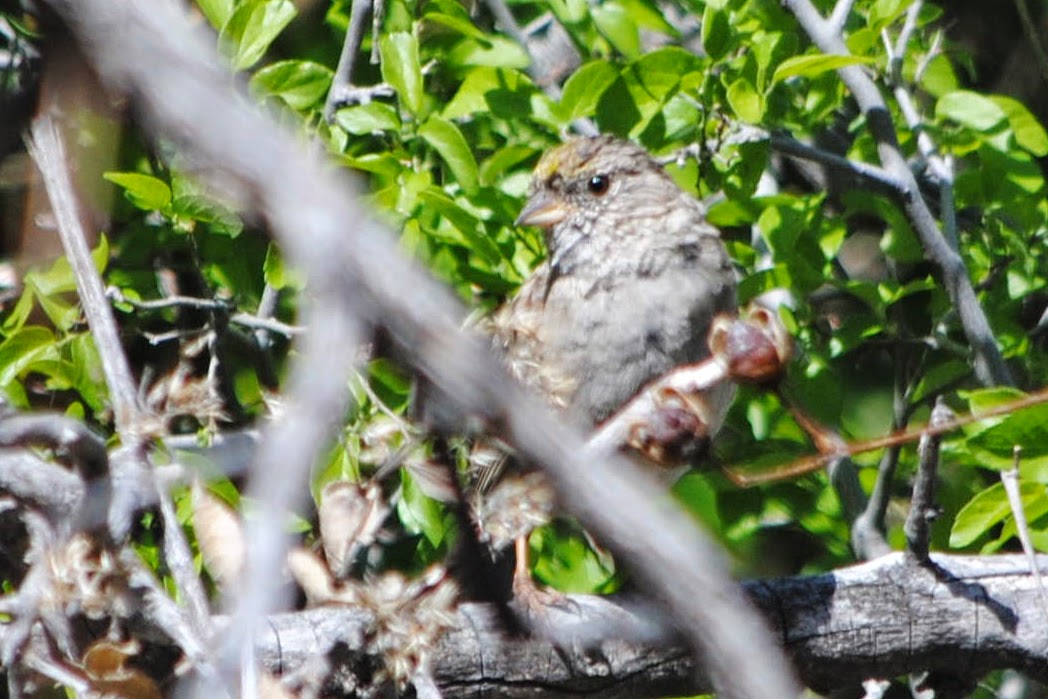
Florida Canyon! The first two things that come to mind when an experienced birder hears that name is Black-capped Gnatcatchers and Rufous-capped Warblers. Both the BCGN and the RCWA are Mexican vagrants that have been known to breed in Florida Canyon in very small numbers. As I said in the last post, the Black-capped Gnatcatcher was my target bird for the trip, so you might ask "Why not the Rufous-capped Warbler?" Well at the time I didn't know where the RCWA was and I hadn't been to Florida Canyon before. But once Mr. John and I pulled into the parking area I was very exited to explore yet another new birdy area. I quickly jumped out of the car and started calling out birds "Gray Hawk, Broad-billed hummingbird, Plumbeous Vireo, Black-headed Grosbeak" before long I was up to thirty species, and I was still around the parking area! But there was one set back, Mr. John was tired by our previous day of hiking around the Museum. So we agreed that he would stay back at the parking lot and bird around the small but active area while I hiked up the canyon a ways. However, I came prepared and brought my walkie-talkies that I use back at home when I go birding by bike. As I literally ran up the canyon I came across a fellow bird-guide Mr. Richard Fray, who kindly gave me directions to where he had seen a few birds like Rufous-capped Wabler, Elegant Trogon, Montezuma Quail, and a possible Golden-crowned Sparrow. So becoming even more pumped (almost to the point where my brain could've exploded!) I started running even faster only in a "Bird Hard" fashion. Before long I started slowing down as the trails started splitting more and more. As I was hiking at a fast pace I had a couple of birds explode into flight from what felt like the tip of my nose, Montezuma Quail (Lifer #3 for the trip)!!! The two birds took flight in two different directions and trying to keep track of either one of them proved very hard. I then spotted a pair of Golden Eagles in the distance as they used the ridge line for transportation, but the birds were way to far for a photo. Soon after, I found myself about a mile up the trail where the habitat along the creek started disappearing so I started working my way back when I spotted a plain gray-faced Zonotrichia fly into the creeks thick brush. All it took was that very brief glimpse to identify the sparrow as a Golden-crowned (Lifer #4 for the trip and 350 for my life)! I then patiently waited and after a bit of pishing the bird came out!

Golden-crowned Sparrow 


Honestly, this has got to be the drabbest bird I've seen in my life!

The sparrow then flew down into the brush again, and as I was waiting for the bird to make another move when I got a call from Mr. John that he was staring at the Black-capped Gnatcatcher with Mr. Richard, and it was sitting on its nest!!! I then told him that I was on my way, but as I started running I spotted a Golden Eagle soaring overhead and a Gray Hawk was attacking it!

Golden Eagle

Golden Eagle--And babam, Gray Hawk!


Once the Gray Hawk retreated I then continued running down the canyon for a half mile before I reached the parking area. I then found Mr. John and after scanning the tree branches we found our suspect (Lifer #5 for the trip)!

Black-capped Gnatcatcher--Female
Note the long bill and white undertail that separate this unique gnatcatcher from the others.

We then pointed out the gnatcatcher to some other birders and we continued snapping pictures.

Black-capped Gnatcatcher


After watching the gnatcatcher for a while we decided it was time to hit Madera Canyon, but on our way we stopped by a cow corral to see what we could find. I didn't find the male Black-capped Gnatcatcher that had been staying here but I did, however, hear and get a couple looks of my lifer (#6 for the trip!) Northern Beardless-Tyrranulet. I tried hard to get more looks and possibly a photo but that bird was just so darn small! We then continued towards Madera Canyon where we made our first stop by the Super Trail near the top of the canyon. I hiked about three quarters of a mile before I decided I probably wasn't going to crush any trogons on the trip. We then made our last stop of the day at the Santa Rita Lodge where we saw some cool birds.

Mexican Jay

Wild Turkey

I ended the two day trip with an awesome 6 lifers to talk about and 25 year birds bringing my year list to 250! I am looking forward to my next trip to SE AZ and who knows what lifers I might get on that trip. Thanks Mr. John, Mrs. Janet, Mrs. Jennifer, and last but not least Ren for an awesome trip!